Friday, 29 April 2022

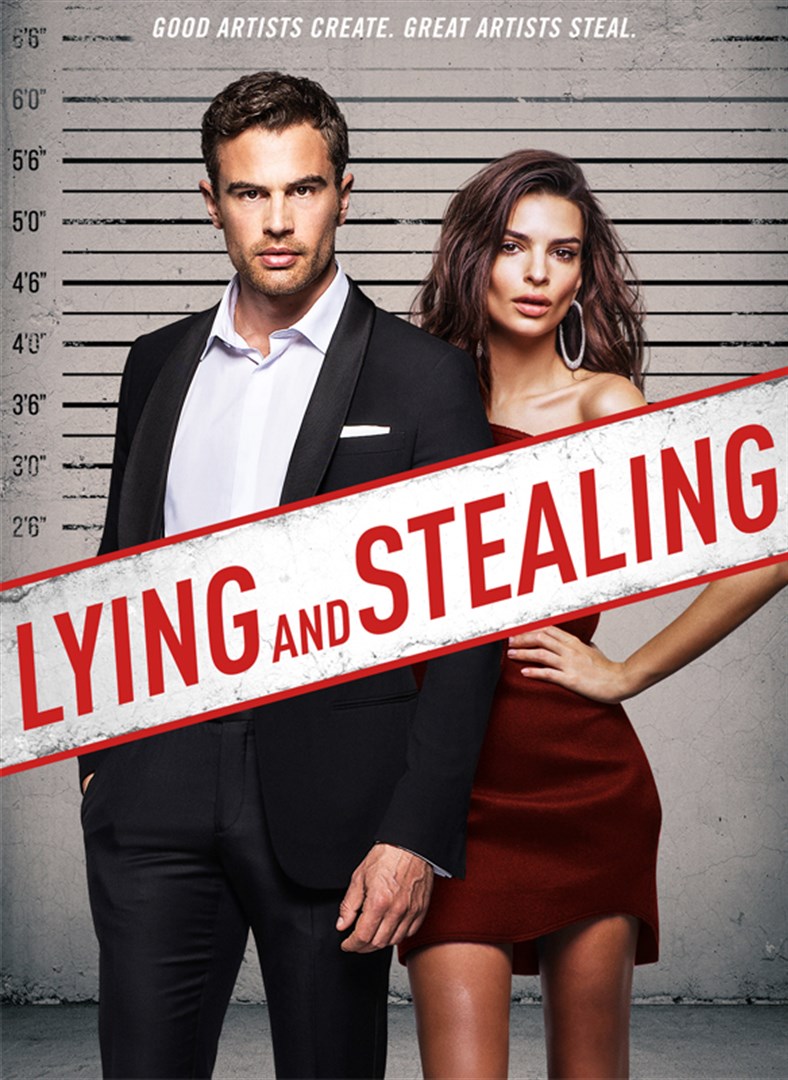
Lying and Stealing (Matt Aselton, 2019)

Art thief Ivan (Theo James) is looking for a way out of the game. Making it harder is that he is indentured to a local crime boss (Fred Melamed) who picks his next score.


When he meets an actress-turned-con artist Elyse (Emily Ratajkowski), Ivan finds a partner to help him complete one last job that will allow both of them to leave their current careers behind.


A few weeks ago, I rewatched a movie I used to love: I Come In Peace, a low-budget sci-fi action movie starring Dolph Lundgren. 


It is not a great movie, but there is something about the low-budget presentation, and how the filmmakers manage to create an effective genre piece within those limitations, that makes it more fun to watch. It is no masterpiece, but it succeeds at what it sets out to do.


The success of movies like I Come In Peace is worth highlighting because they are operating in a space now held by major studios with massive budgets. In its own humble way, these kinds of low-budget genre movies democratic-ize and demystify the process of filmmaking.  


Lying and Stealing is not a great movie. I was not even sure I wanted to write about it.


But I could not shake the feeling that this modest caper was a spiritual sibling to I Come In Peace.


The 2019 iteration of a low budget genre movie, it is not great, but there is something about the way the components are put together, without the bells and whistles, but with just enough invention and intelligence that it is entertaining.


These movies are associated with money, both onscreen and off:


You expect an all-star cast in exotic locations. Instead you have Theo James and Emily Ratajkowski in Los Angeles.


Perversely, the lack of resources gives the movie a sense of verisimilitude.


The lack of excess in the miss-en-scene draws attention to the characters’ isolation and the hoarding of wealth.


If this movie was big budget, the stars’ lack of star power would stand out. 


But because this movie is made on a modest canvas, they fit. 


Overall, within the bandwidth of this movie, I think they are pretty good.


James is probably more together than the character as written, but he is fine as a handsome blank who can slip in and out of his wealthy prey’s homes.


Ratajkowski is a little exposed during the climax - she does not show the level of anxiety the character is supposed to have. There is a bizarre inconsistency that almost feels like the filmmakers chose the wrong takes, because her performance changes drastically between shots.


She is also sharing the screen with the movie’s MVP, Fred Melamed, who lifts every scene he is in. He brings genuine menace to the film, and I wish the movie could have made him more of an antagonist.


Isiah Whitlock is also good as the FBI agent who gets on Ivan’s tail. Once again it is a case of a great actor in a minor role that does not give them much to do.


Despite their limitations, I am kind of interested to see if James and Ratajkowski can get some more roles like these under their belts - they may not be great, but they know what kind of movie they are in and they are not mannequins. 


Overall, I kinda liked Lying and Stealing - probably because of low expectations, but it is better than the unappealing title.

Christine (John Carpenter, 1983)

Like any 21-year-old in 1978, Christine is obsessed with rock’n’roll. She is also looking for love.


The ‘57 Plymouth Fury has its headlights set on nerdy teen Arnie Cunningham (Keith Gordon).


And there is nothing he or his friends (John Stockwell, Alexandra Paul) can do about it.


I am a big fan of John Carpenter’s work, but this was one of the few of his flicks I have not seen. Ironically, it is also the only Stephen King book I have read.


Christine is not a great Carpenter movie, but Christine herself is top tier.


Whereas the novel complicates its villain by including the spirit of its former owner, the cinematic Christine is a pure Carpenter antagonist.


From the opening scene, in which she is introduced on the assembly line, to the strains of George Thorogood’s ‘Bad to the Bone’, we are left in doubt that Christine was bad from the beginning. 


While the movie is pretty earnest, that initial song selection establishes the fine layer of irony that gives Christine (and the movie) a little more life. 


A lot of this is down to the music. Carpenter is a filmmaker defined by his music, and while his score is fine, the movie comes alive in the selection of rock songs used to provide Christine’s ‘voice’.


The songlist is a list of tracks from Christine’s era of manufacture, and help to give the car her vindictive, darkly mordant personality (Little Richard’s "Keep A-Knockin'" plays when an uninvited guest tries to open the door).


While the idea was later borrowed by the Transformers films, the use of songs for Christine feel more incisive in communicating her emotions, and her fixation on her new owner.


The scene where Christine reassembles herself to the tune of the Viscounts’ version of ‘Harlem Nocturne’ almost feels like a seduction, as she finally reveals herself to Arnie.


While the story could be seen as a metaphor for puberty and sexuality, or America’s obsession with cars, or a dark rebuke to eighties America’s obsession with the fifties, Christine is not really about anything more than what it says on the tin. 


It is handsomely produced, and feels of a piece with John Carpenter’s other films from this period, but it never rises above merely watchable.


As far as the performances, Keith Gordon is excellent as Arnie Cunningham. He manages the transformation from nervy wallflower to obsessed loner, although the film never really figures out the resolution in a particularly satisfying way. Arnie becomes Christine’s and becomes a side player during the third act, as his friends fight to destroy Christine.


Stockwell and Paul are fine as, respectfully, Arnie’s best friend Dennis and prospective love interest Leigh. As already stated, these characters are bystanders to Arnie’s downfall, and only become active in the climax. In the book, Dennis is the narrator of Arnie’s story, and that inner monologue gives more context and depth to the characters’ relationships. While the actors have a good rapport, the movie lacks the same sense of character investment.


Overall, Christine is elevated by the execution of its title character, but otherwise it is just solid. 


Thursday, 28 April 2022

BITE-SIZED: The Car (Elliot Silverstein, 1977)

 A dark car is running over pedestrians in an isolated rural community.

It falls to local cop Wade (James Brolin) and his department to chase this speed demon down and find out who is behind the wheel...


Released in 1977, The Car takes the basic template of Jaws, swaps out the water for the open road and the killer fish for a killer car.


I watched this movie after John Carpenter's Christine, another killer car flick, and it might have been a better idea to watch it beforehand.


The Car is not a good movie. The dramatic storyline is just a group of vaguely defined characters reacting to the car amid their own boring lives. The acting is fine but the movie drags every time the titular car is offscreen.


Ala Jaws, the movie crisscrosses between car attacks with the police investigation and sequences of Wade’s relationship with his daughters and a local school teacher. Unlike Jaws, these scenes do not deepen our understanding of the characters, and feel like cheap ways to make us care about people who will die in the next scene. There is a subplot involving a local man (RG Armstrong) who abuses his wife which ends with said guy becoming the Quint of the movie, using his suspiciously large supply of dynamite to help Wade defeat the Car. It is bizarre.


Mixing the Jaws plot (small town terrorized by a monster) with a car almost makes the film feel like a dare. It almost reads as parody as our heroes try to dodge a vehicle that growls and lunges like an animal. 


And while the Car is a great antagonist, certain scenes come off as cartoonish rather than scary - the Car’s somersault(!) into the path of charging police vehicles is awesome, but not in the way the filmmakers intended.


Leonard Rosenman provides an atmospheric score, and Gerald Hirschfeld’s daylight photography - with its dutch angles and exaggerated use of perspective - adds to the movie’s uncanny vibe.


It is pretty cheesy, but on its own terms, The Car is pretty entertaining.

Friday, 22 April 2022

Village of the Damned (John Carpenter, 1995)

Something strange is going on in the little village of Midwich. 

First, everyone within the village fell into a deep sleep. 


After they woke up, all the women discovered they were pregnant. 


When the children were born, they were all strikingly similar blonde moppets.


As they children grow, the adults become more suspicious of their offspring...


A couple of years ago I watched the original Village of the Damned. I was a fan of the book and so a little lukewarm on the adaptation.


John Carpenter is one of my favourite directors, so I was interested to see his take on the familiar story.


Simply put, he does not have one. This remake has no reason for being.


First things first, the kids look ridiculous - the hair and the computer-generated eye effects are not effective.


There is no attempt to adapt the movie for colour, the nineties or an American setting.


What was disconcerting was how poorly paced the movie is.


It never feels like scenes are propelling forward, and while Carpenter is a visual filmmaker, there are potentially cinematic moments which are skipped over or conveyed through dialogue. 


This feels like an effect of the adaptation - the 1960 film was styled like a docudrama, which allowed for a certain sense of time compression and looser narrative flow.


This movie is shot like a classic Hollywood drama, with continuity editing, so the story feels oddly staggered.


Most of the acting is low key, which works against any sense of mounting tension that the film tries to convey. Reeve is patchy as the lead - he has a few moments where he seems plugged in, and reacting to the children’s deeds, but for the most part he is underselling.


As the mysterious government rep, Dr. Verner, Kirstie Alley is even more low key - she is not bringing any sense of tension or fear. In scenes where she should show… something, like the birthing sequence, or when she tells Dr Chaffee (Christopher Reeve) about the fate of the other children, she is just casual.


I was expecting her to turn out to be some kind of cold fish villain who would  betray the townspeople but nothing happens - it is just a poorly judged performance.


The one vaguely interesting turn the film comes up with is the idea that the Children are paired off with some kind of mind-link.


One of the children, David (Thomas Dekker), is alone because his partner died in childbirth. That idea never goes anywhere because the story is locked into the structure of the original. 


 It would have been more interesting if the film had focused on David and his relationships with his mother (Linda Kozlowski) and Dr Chaffee as he begins to develop more human feelings. 


But this movie is not interested in digging into that idea. It is not interested in digging into any aspect of its story’s characters or themes. It is just a plot summary of the old movie, just in colour.


The best thing I can say about it is that it made me want to rewatch the original and read the book, which feels more invested in its characters and the village as a community.


What is worse is that there is nothing particularly specific that feels like Carpenter’s imprint. It just made me want to watch The Fog, They Live and The Thing again, which deal with similar ideas in more interesting ways.


Like the Children, this movie is a lifeless facsimile. 


Related


Village of the Damned (1960)


Monday, 18 April 2022

OUT NOW: Ambulance

 Needing to support his family, Will Sharp (Yahya Abdul-Mateen II) turns to his brother Danny (Jake Gyllenhaal) for help.


Help turns out to be a bank robbery with a haul worth 32 million dollars.


When the robbery goes wrong, the brothers end up in an ambulance with a wounded cop (Jackson White) and an EMT (Eiza González)  trying to keep him alive…


Ambulance is a type of movie that I love, a one-location thriller along the lines of Speed or Unstoppable. 


And on top of that, this movie has great bones. It has some thematic meat (America’s health care system is basically the villain) and some solid character arcs for the key players. 


I want to give it credit for these things because for most of its two-and-a-half hour runtime I was frustrated by the gulf between the script and Bay's established style.


This movie is a prime example of how to screw up basic geography.


Michael Bay is always going to be Michael Bay - he has never been a favorite of mine, but I will admit that there were a few times I was happy to see the old trademarks: the low angle, the lense flares, the slow motion, the 360 degree shots.


After two-and-a-half hours I was exhausted. I was also narratively and spatially lost.


I think the script for this one is solid, but in terms of how it is told, Ambulance is a failure. 


The story boils down to a chase, with the conflict between the occupants of the titular vehicle. This story requires as a base minimum that we can follow the vehicle as it moves through locations, understand where it is in relation to pursuit vehicles and obstacles.


Despite the material, Bay still over-cuts his scenes, and is incapable of providing an establishing shot so that we can follow what is going on. There were multiple moments where I could not figure out where the characters were in relation to each other in the ambulance. 


There are times where Bay’s aesthetic preferences work for the movie - the character’s growing sense of entrapment, the fetishisation of police hardware reinforcing how hopeless their situation is.


The movie can be claustrophobic - but most of the time, it is because the filmmakers have failed to establish a clear sense of geography.


The actors are fine - Abdul-Mateen II gives the movie a sense of pathos (he does have the best character), while González adds a flinty professional veneer to her beleaguered hostage. Gyllenhaal’s hyperactive performance feels more at home with Bay’s style, although it felt a little disconnected from the rest of the cast.


Overall, Ambulance is a frustrating overlong thriller that deserved a more pared-down and restrained execution.

Tuesday, 12 April 2022

OUT NOW: The Contractor

 Discharged for using a banned substance to treat an injury, former Special Forces Sergeant James Harper (Chris Pine) needs a job.


He has a family to provide for, and the bills are piling up. 


When an old friend Mike (Ben Foster) offers him a role as a contractor for a government contractor, James takes it.


And then his first mission goes wrong…


I watched this movie because of Chris Pine, and he was the thing I liked the most in it. 


The Contractor has some worthy themes and some solid character beats - I just wish I liked it more.


A thriller about veterans who become private contractors in order to support their families, The Contractor reminded me a lot of Little Woods, in how it is about the crushing economic pressures of living in America. And like that movie, the only answer is shady business.


There is an aspect to the movie that feels closer to horror than action - our protagonists are treated like chess pieces that are moved from place to place with no real idea as to why.


They are also trapped between normal life and their experience of war and soldiering.


Pine’s performance is really fascinating - the character wants to be home yet in the domestic scenes, Pine feels disconnected, as though he has no idea what normal means.


The movie is far more interesting in this first half, as James tries to reconnect with his wife Brianne (Gillian Jacobs) and has flashbacks of his domineering father.


Once the mission starts, the movie starts to feel less singular.


It is not bad - the fight sequences are competently staged and rather visceral - but there is something missing.


It is as if the hollowness affecting the characters is affecting the movie and it does not know how to reconcile itself.


It almost feels like the themes and ideas that the movie wants to tackle - around treatment of veterans, and the destructiveness of American foreign policy - are too big for the story the film wants to tell. 


I could not help a sense of frustration with the genre elements of the movie - they feel so familiar and uninspired that I checked out. 


The movie is more effective when it is just a slowburn chronicle of a man’s breakdown.

The scene where Pine finally explodes is the best thing in the movie - a cathartic howl from the gut that is far more impactful than any of the action sequences. It recalls the frenzied intensity he brought to I Am The Night. 


The movie has seeds of greatness, but ultimately The Contractor's presentation is a little too rote and dull for its worthy contents.