Monday, 6 January 2020

6 Underground (Michael Bay, 2019)

In an attempt to right the world's wrongs, a mysterious billionaire gathers a team of specialists to take down the threats no government will touch. Having faked their deaths, and boosted by their leader's financial resources, this oddball team turn their sights on a despotic dictator responsible for war crimes against his own people.


After a decade of Transformers, Michael Bay has returned to R-rated mayhem.

In many respects it feels like classic Bay: arbitrary angle and camera moves, rapid editing, magic hour, bizarre lashings of comedy, general tonal incoherence and a complete disdain for human characters.

Despite the presence of Reynolds and his writing collaborators Paul Wenick and Rhett Reese (Zombieland, Deadpool), there is little to differentiate this movie from Bay's previous work. I am not a fan of Bay, but there was something weirdly reassuring while watching this film.

Amid the shapeless dross of most Netflix product, 6 Underground looks and feels big - Bay's aesthetic has its critics, but with how flat and uninteresting most Netflix releases are, there is something pleasing about his overheated nonsense.

That being said, the film is far less nuanced when it comes to other aspects of its story and characters.

The plot is based around our hero - a billionaire tech bro - discovering his humanity after watching thousands of people lose theirs in a chemical attack orchestrated by a brutal central Asian dictator. After faking his death, he assembles a team of experts in various eclectic fields and turns them into a private version of the Dirty Dozen.

The parallels to Assad are as subtle as a bus to the face, and while the movie does reference how major powers play a part in installing these regimes, the answer the movie has to have our heroes' mission be focused on toppling the tyrant and replacing him with his benevolent brother.

While the premise is interesting, 6 Underground is best viewed as a collection of set pieces. The characters get some business to do - there is a romantic subplot between a former cartel gun man and an ex-CIA agent that takes up most of the non-action moments - but this is not a movie that delves too deeply into making its core group make sense.

The film is more interested in the idea of a group of outsiders finding family together than making that a major element of the text. Outside of Reynolds' One, we never really get a sense of what motivates our heroes.

And One's backstory does not make him that endearing - he just comes off as a bit of a prick. While his motive is understandable, there is something odious about a rich white guy learning empathy from watching the genocide of thousands of poor brown people.

It might be the affect of the filmmaking, but outside of the gassing sequence, the film never feels that concerned with humanising the people of the country - other than the Tyrant's brother, the group have no ties to the country. While it is arguable wether it is necessary to get too into the sociopolitical context of an imaginary country, it is hard to see what the group is fighting for. They do not even have allies among the locals.

While Bay's return to full-throttle action will be welcomed, at a certain point I began to think about how expensive this movie was, and the number of other filmmakers with similar pedigrees who could have used some of Netflix's largesse. 

If you are onboard for Bay, 6 Underground is worth a look. Otherwise, the John Wick movies are readily available.

If you are new to this blog, I also co-host a podcast on James Bond, The James Bond Cocktail Hour. 

You can subscribe on iTunes, or wherever you get your podcasts.

Sunday, 29 December 2019

IN THEATRES: Cats

You know what this is.


I watched it last night. It has been two days and I am still trying to reconcile what I just watched.

I have not had an experience like this movie since I ran out halfway through Martyrs. I was laughing, I was crying, I was screaming for it to end.

But I could not look away.

The movie starts and already feels like an assault. A car stops in an alley, a massive human figure drops a bag among the garbage and drives away.

A group of cat-people cluster around the bag and tear it open to reveal Victoria (newcomer Francseca Hayward), a naive young cat who becomes our guide into the world of cats.

We are immediately launched into a song as multiple cats start singing about being 'Jellicle cats'. Before we even have a sense of the location OR the characters we are meeting, the camera starts swirling around and the editing goes into overdrive - but rather than capturing the energy of the song, it only disorients who is who and where everyone is in relation to each other.

It is a lot to take in, and it establishes the basic sensation of watching Cats.

Through out the movie, I was enraged and impressed by the film's unwillingness to give non-fans a break. And there is almost no downtime. We go from song to song to dance number to song with no let up.

There are a few beats of spoken dialogue, but there are no downbeats, and no silence. This is wall-to-wall sound and motion for 110 minutes.

The transition between these moments are so arbitrary - at no point did I feel settled. Often there are no signs ahead of time that a new song is about to happen.

Sometimes a song about a particular character will start and since half the words are made-up nonsense it is hard to tell if they are talking about a cat or a concept. And then said character will appear, and I have a new uncanny face to haunt my brain box.

Speaking of which...

The stories of the unfinished effects have already added to the tale (har har har) of this movie - I am pretty sure I saw the un-corrected version (one of the cats seemed to be wearing sneakers in the first alley scene).

The effects are all over the place - sometimes characters' faces seemed to float free of their heads; background characters are either poorly rendered or out-of-focus.

Bad effects are one thing but when they are used to pull off some of the ideas in this movie, it tips over into genuinely unnerving.

Yes, the cats are people. But the mice are also people (with CGI faces of children, as if it was not disturbing enough).

AND there is an army of dancing cockroaches who are also anthropomorphised - we get to watch the cat people eat them.

There is even a scene where a dog shows up, but sadly it is kept offscreen.

Onto the sex!

I heard from people online that the movie was 'horny' but it is merely one component of all the surreal sh*t going on in this movie.

There is something so off-putting about these half-digital characters, and then combined with the environments, and the way that Hooper shoots them, that constantly throws off your attention. There a few moments where the characters do not seem to be interacting with the settings they are in - they either float above the floor or stand in front of backdrops that lack depth (the person I went with muttered that it looked like a Tim and Eric skit).

One of the key weaknesses of the film is that there is a severe lack of unity between the camera work and the edit. All film is based on a unity of affect - how a shot is composed is just as important as how these shots are juxtaposed with each other.

With Cats, I often found it had to tell where people were in relation to each other, or who they were looking at. There are a couple of set pieces where characters are singing toward a point out of frame but the frame is so tight I have no idea where they are, and the shots go on so long I felt boxed in.

I felt like I was trapped in a box watching this movie - which is bizarre because there is quite a lot of choreography and movement. But the pacing is all wrong, and the editing of every scene drags every moment past the point of tedium.

Every element of this movie is designed - however inadvertently - to keep you on edge. It is an achievement.

I found myself concentrating so hard to understand what was going, how it was conceived, and why it was conceived in the way it was.

Who is this movie for? What is it about? Who is the main character? Why is Judi Dench breaking the fourth wall?

After it was over, I felt like I had been through some kind of ordeal. My head was sore, I wanted to throw up and I could not stop giggling. The reason it took this long to put out this review is because I was still trying to get over the hangover of it.

But now that the movie is out of my system, I find myself unwilling to condemn it.

This movie is a unique beast. You get big bad movies all the time, but most bad movies do not stick with you. And most of them feel like bad copies of other movies.

Cats is not an ordinary bad movie.

It has a singular vision, and every choice it makes is designed to nudge the viewer closer to the edge. But it is committed.

And while the acting is al over the map, every performance is 110% earnest. They are invested to the most embarrassing and sugary degree.

This movie made me physically ill - my head felt like it was being squeezed; I was giggling uncontrollably and crying out of one eye.

There is something glorious about the fact that this movie, backed by a major studio, with this crew and cast, managed to make it through the system without being noted either to death or to blandness. Because this movie could have been excruciatingly boring.

But it is so singular and focused on whatever the hell it thinks it is that it ends up being that rarest of beasts - a legitimately great terrible big movie.

This thing is going to be immortal. There will be cult screenings of this for years to come, with in-jokes and audience rituals that people will know and parody.

For while the filmmakers may have not had an idea of what the audience was for this movie, there is one. And they will give this movie legs long after Universal has pulled the plug on its theatrical run.

More personally, those freaky human faces on cat bodies are chiseled into my retinas till the end of time.

Ignore its title and subject - this movie is a unicorn in a forest of corporatised banality.

GO SEE CATS.

Monday, 25 November 2019

Hustlers (Lorene Scafaria, 2019)

Inspired by the New York Times article about a group of strippers who drugged and robbed their ultra-rich clientele, Hustlers is a story about women operating in a men's world. Thematically, it comes across like a more upbeat take on Widows, with a group of women forced to take drastic actions to carve out lives in a system designed to subjugate and exploit them.


A prime combination of real-life crime drama, a familiar social context and women coming together to form a self-made family, Hustlers is one of the most enjoyable times I have had at the movies all year.

I used to be able to have a take on almost every movie I saw. Nowadays, I feel less inclined. Partially, it is a growing sense of which kinds of films I have enough of a foundation in (thematically, generically etc) to make an interesting argument; the other is inspiration.

And, frankly, there have not been many movies that have inspired me to write lately. Not that it has been all rubbish. There have been some great movies I have seen - but the muse just was not on-board.

The last couple of weeks, it feels like the dam was beginning to break - and Hustlers was a big reason for the breakthrough.

I do not know where it started, but I have always been a fan of movies centred around women coming together to solve a specific problem (Do not mistake this as a sign of some greater 'woke-ness' or sensitivity on my part - as noted in a previous review, I did not see The Craft till a week ago because of ingrained YA bias).

There is something inherently dramatic about women and female friendship, sans any romantic component. Past movies that fell into this category include last year's Widows, or Whip It, Sunshine Cleaning,  - even if the stakes are small, there is a real satisfaction from witnessing this kind of camaraderie. And that spirit of togetherness is a big part of why I enjoyed Hustlers so much. 

Right from the beginning, Hustlers sets out its thematic foundation: before we see any of the characters or the club they work at, we hear the opening lines to Janet Jackson's 'Control'.

'Control' and its parent album signaled Jackson's break from her father's control and the pre-fabed version of pop on her first two albums. An important meta-textual reference point, the song lays out the movie's underlying theme: women taking control of their lives from the men who think they are instruments of their own desires.

It never felt like the filmmakers were leaning into the exploitative potential of the story and the characters' profession - there is not much flesh on display and the only time we see a stage number is the introduction of Jennifer Lopez's Ramona - even then, it is not solely about her sex appeal. The scene is framed from Destiny's POV, the camera sharing her fascination and admiration for the star of the show.

Let's get to Ms Lopez first. I have not seen Jennifer Lopez this deep into a role in years. She's always been good, but it always felt like she was trawling in the shallow end, trying her hand at Sandra Bullock-style rom-coms and a few Ashley Judd-style thrillers. Nothing against either of those two actresses, but it felt like Lopez did not quite fit those roles.

One of the big selling points of this movie was Angelica Jade Bastien's review, which eulogized Lopez's performance, and she was not kidding:

From the moment she appears onscreen, Lopez comes across like a queen; throwing off her cloak to reveal flesh feels less like titillation and more like a power flex. While Ramona's power is partly carnal, it is only part of it - her power goes from knowledge and experience - she knows how to navigate and out-maneuver the men who have the power and the money. They are merely obstacles standing between her and what she needs.

This is the first time where she has a role and a movie that fits her like a glove - there is an inherent steel to Lopez that has rarely been utilized in her previous roles. In most of her romantic comedies, she seems to play characters are meant to be more ditzy and  less together, which never fit - she always feels far smarter than the roles she plays, and Ramona is a character that is all brain all the time. 

What I loved about Lopez's performance is what I loved about the movie as a whole - none of the characters are villains. There is no virgin-whore binary here. These women are human beings, and film never demonizes their profession.

As the lead and heart of the movie, Constance Wu is great as Dorothy/Destiny - someone who is smart enough to put on a front, but too empathetic to keep it on. Wu exhibited a real pathos and vulnerability in Crazy Rich Asians, and that quality is magnified here.

It is great to see Keke Palmer in this - she gets some great comedy beats, although the role does feel like it exists solely to be comic relief.

If you are coming to the movie for Cardi B and Lizzo, they are both effectively cameos - although Cardi does get an important scene teaching Destiny how to lap-dance.

Cardi B tells our heroine to 'drain the clock, not the cock' and it sums up the movie - this story is not about the men, who ostensibly hold all the money and power - this is about these women working to hack out their own piece of the American Dream, here a rancid fantasy that can only be taken by laser focus and ruthless ambition.

The soundtrack is a highlight - not only is hte movie bookmarked by two of Janet Jackson's best dance songs, there is a strong selection of bass-charged tracks by Britney Spears, Usher and - in one pivotal scene - Lorde's 'Royals'.

The movie has a wicked sense of humor - there is a masterful sequence involving the central cast as they transport an unconscious client past a cop car. A tense sequence broken up by two great comic beats, it is a great example of the movie's delicate control of tone and the moving parts of the story.

Back by a great soundtrack, Hustlers is one of the most enjoyable movies I have seen this year, while also offering considerably more than what the average punter (or the raincoat brigade) may expect.

If you are new to this blog, I also co-host a podcast on James Bond, The James Bond Cocktail Hour. 

You can subscribe on iTunes, or wherever you get your podcasts.

Sunday, 10 November 2019

IN THEATRES: Terminator - Dark Fate

28 years after Sarah Connor (Linda Hamilton) prevented Judgement Day, a protector from the future has arrived to protect another young woman from a new breed of Terminator. The same nightmare? 

Not quite...


...but mostly the same, yes.
When I was growing up, the first two Terminator movies were mana from heaven. My dad had a habit of telling me about R-rated movies that I was not allowed to see. The Terminator was this weird mythical thing that I only vaguely understood. For some reason, my mum was more agreeable on these movies and rented them on a weekend when dad was out. I cannot really remember what happened or why she thought these movies were fine for a 10 and 8-year-old but ah well.

My brother and I watched them, loved them and ran around in the backyard pretending to be robots.

A few years later, I was given T2 on DVD - it was the two disc set with about 1000 special features, breaking down how they made the movie. Watching those special features, and seeing how these movies were put together got me interested in filmmaking in a serious way.

For a couple years, The Terminators were my favourite movies. And then the other sequels happened.

Terminator 3 was disappointingly fine - I don't think I've watched it more than once, but the only things I like about the movie are its fantastically bleak ending and a deleted scene which explains how the T-101 got its human face.

I have a soft spot for Terminator Salvation - it throws away the formula and tries to create a feature-length story set in the future war: sadly said story is so muddled it never amounts to anything dramatically. By the time Genysis I was less attached to the franchise, and did not bother to see it. I was not sure I would go see this movie but I heard some good things, and the return of James Cameron in a proper creative capacity lured me in.

And it was a pretty good time. Dark Fate is not on the level of the first two, but it is pretty good.

While I enjoyed this movie, there is a sense that this is the end of the road - and not just in terms of the diegesis. Ala Halloween 2018, Dark Fate cuts out the non-James Cameron entries, and re-centres the film around original lead character Sarah Connor.
While it has a more solid story than the last two entries, like the last Halloween, Dark Fate suffers from an overriding sense of familiarity - and not just because it replicates the same story structure as Cameron's movies.

The funny thing about Dark Fate is how much it feels like a reboot of elements and ideas from the last couple movies: Like Terminator 3, it features a villain who blends a metal endoskeleton with a liquid metal covering. It even borrows T3's method of dispatching the villain. Like Salvation, it features a human character who has been augmented with Terminator-style technology. Like Genisys, it is in focus.

Because of the echoes, I was not that intrigued by the new machines - the liquid metal gimmick has been done, but the series cannot seem to move past it. That being said, Gabriel Luna is great in the role - the quiet intensity he brings feels in the same range as the blank menace of Schwarzenegger in the original and Robert Patrick in T2.

I just wish the movie treated him with a little more weight.

While I enjoyed the movie, I was not in love with the aspects of the production - there was an incoherence to the editing of the action sequences, and the filmmakers are far too enamoured of the machines' abilities, deploying the same rubbery physics that are detriment to modern action films.

One of the key elements of Cameron's movies is how they lean into the nightmarish aspect of the premise - part of it is the nature of how action films were made, but one of the best aspects of those movies is how they ground us in Sarah and John's POV - they feel like ordinary people watching and interacting with these otherworldly beings.

In Cameron's hands, the Terminators are terrifying. In Dark Fate, the Rev-9 only feels threatening when it is just Luna walking through unknowing civilians.

While the execution is spotty, the story - while familiar - actually bothers to lean into genuine science fiction, as it comes up with a new look at how time travel has affected the future.

Even Arnold's appearance carries more weight than I expected - post-Salvation, it feels like an obligation to have Arnie show up, but this movie manages to use his appearance and age to its advantage to answer the question of what happens after a Terminator completes its mission.

What is great is that the filmmakers lean into the fact that this particular model is a different character from the previous ones: 'Carl' has remade himself as a banal family man, working an incredibly boring job selling drapes. Schwarzenegger is gifted with the lion share of the comedic beats but, unlike Terminator 3, these moments are peppered through the movie with enough tact that they do not detract from the drama.

The new cast are really good - Mackenzie Davis makes for a solid addition to the Cameron Action woman archetype and Natalia Reyes is good as the young woman she has to protect. They are so good, I almost wish there was a version of the movie without the old guard.

 My big takeaway from the movie is that I wish it did just a little more to stand out on its own. But do not take this review as a slam - this is a good movie, anchored by strong performances and builds on what has gone before in interesting ways. It is just after three previous entries, Dark Fate feels like a respectable finale rather than the beginning of something new.

Check it out.

If you are new to this blog, I also co-host a podcast on James Bond, The James Bond Cocktail Hour. 

You can subscribe on iTunes, or wherever you get your podcasts.

IN THEATRES: Joker

Fledgling clown Arthur Fleck (Joaquin Phoenix) is losing his job, his mom and his mind. Thanks to a collection of vaguely connected events, Arthur slowly turns into a painted killer known as 'Joker'.

Ugh...


I was not really interested in seeing this, and now I am actively disinterested in seeing/hearing about it ever again.

Joker is not terrible - but it is a singularly uninspired retread of other movies that has nothing original to say about either its title character or his origins.

This film is clearly referencing The King of Comedy and Taxi Driver, but Joker lacks their bite and their deftness with characterisation and world-building (among a thousand other things). Gotham is recast as the New York of the mid-70s: we get all the popular imagery associated with ‘Fear City’, but there is a disconnection between the story of its central figure and this backdrop. 

As though to hammer home the connections to Scorsese, Robert De Niro appears as a talkshow host that Arthur is obsessed with - in an inversion of his role in King of Comedy that only serves to highlight how silly this movie is by comparison. 

But all this is just window-dressing - under the grime, this is a desiccated plot summary cobbled together from anti-hero cliches. 

Rather than feeling like an inevitable descent into villainy, the film feels like a collection of maybe-catalysts that do not tie together. Combined with overt sign-posting (the yuppies Arthur kills mock him by singing 'Send In The Clowns') and the most ridiculous needle drops this year ('That's Life' by Frank Sinatra and 'Smile' by Jimmy Durante both get played TWICE), Joker is unique in its failure to both signal its intentions while failing to achieve them.

Phoenix brings a frailty and bubbling rage to Fleck, but his performance is undermined by the hamfisted script, which reduces his performance to a series of interesting choices in service of hackneyed, overlong sequences that derail any sense of tension or empathy toward Arthur.

It is difficult to really grasp what the filmmakers' intentions are with this film: is it about the downfall of a man? A critique of Reagan-era capitalism (and by implication, the crises of today)? 

The movie is so drawn out, and filled with bizarre choices (the score feels like a parody of 2010's dramatic scores), that I gave up caring about what it was hamfisted-ly trying to say. There is a romantic subplot setting up an obvious misdirect that went on so long that I actually began to believe it. 

What makes the movie feel even less interesting is the way the movie teases a darkness that it never earns, and neuters whenever it feels like it is about to get problematic: the movie opens with Arthur getting mugged by a group of teens of colour. Later, he is accosted on a train and fights back - the obvious reference points are the famous train-set shoot-out scene in Death Wish and Bernhard Goetz's racially-motivated shooting of four black teens in 1984. 

Based on the opening scene, I was expecting the movie to lean into these antecedents, and build up Arthur's rage on racial resentment. Considering how obvious this movie had been in its messaging and plot points, such a tack would be obvious. Instead, the filmmakers have Arthur kill a group of malignant Wall Street types, an inversion so perfect that it negates what feels like a vaguely logical trajectory for his character. 

There is a wrong-headedness to all these choices that I could not shake. To me, the Joker has always been defined by his lack of identity and clear motivation. Part of the greatness of Heath Ledger's Joker was his lack of backstory - there was a terrifying lack of purpose to his rampage.

By contrast, Arthur is a checklist of bad guy cliches - he suffers from childhood trauma, struggles with mental illness and has an unhealthy fixation on his neighbour (Zazie Beetz). The rooting of Joker's evil in mental illness and the pathology of incels feels wrong, and makes me wonder exactly what the filmmakers are trying to say in this movie based on a comic book property. 

There is the kernel of an idea here - take elements of a popular franchise and give it to a filmmaker to do their own take on it. Sadly, Joker feels more like a logical endpoint of the dark verisimilitude that comic books have been labouring under since the great revisionists (Alan Moore, Frank Miller et al) of the Eighties. 

As a reaction to the increasingly constrictive continuity of the Marvel approach, Warner Bros' decision to green-light one-off movies like this are welcome -  as somebody whose favourite Batman movie is Batman Returns, I will always boost risk-taking.

But as a movie in its own right, Joker is a confused and superficial mess.

I just hope that its massive success leads to other movies that take an off-road approach to familiar characters and scenarios, rather than a series of sequels.

If you are new to this blog, I also co-host a podcast on James Bond, The James Bond Cocktail Hour. 

You can subscribe on iTunes, or wherever you get your podcasts.

Saturday, 19 October 2019

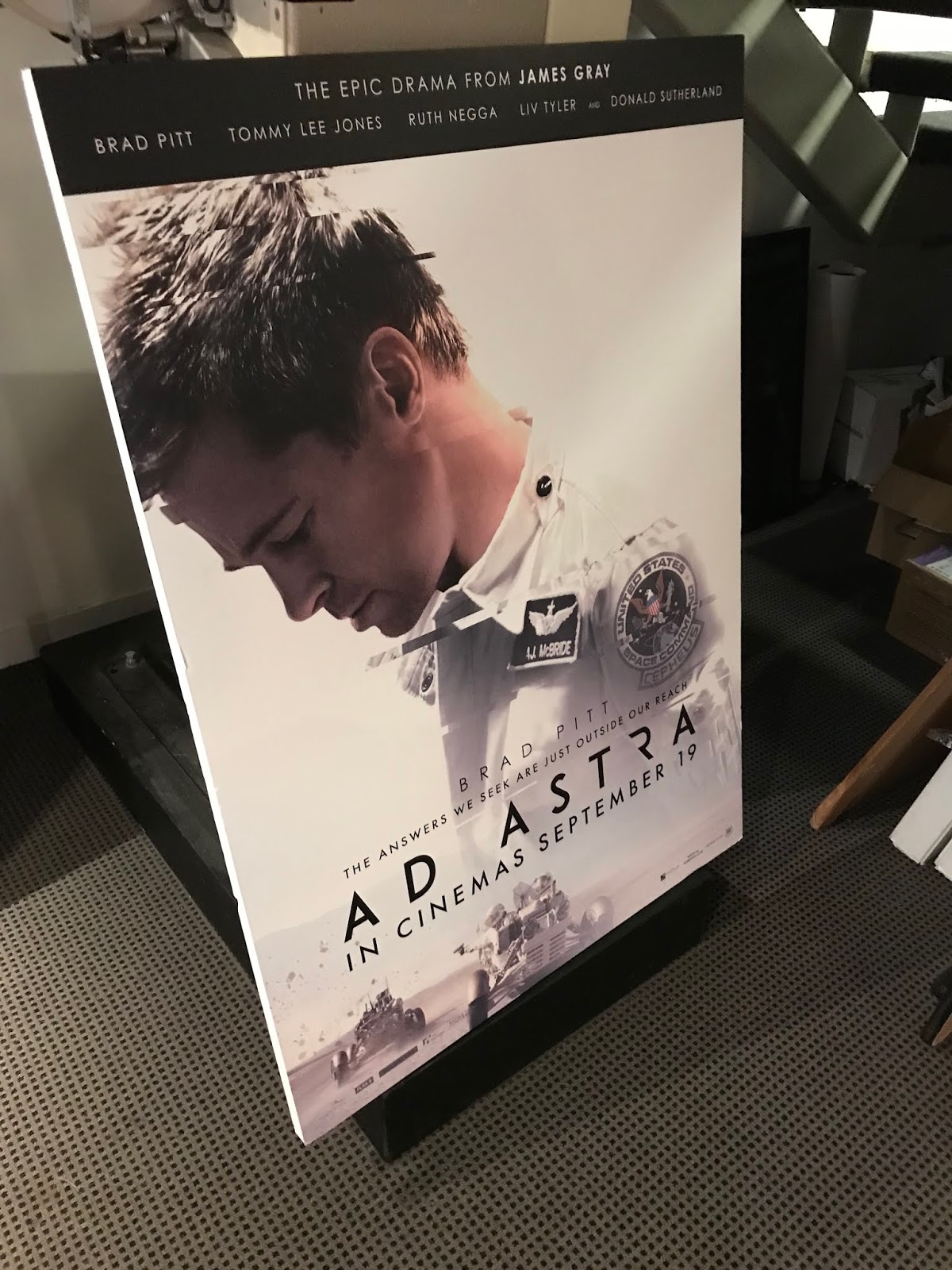
IN THEATRES: Ad Astra

30 years after his father's disappearance on a long-range mission to discover extraterrestrial life, astronaut Roy McBride (Brad Pitt) finds himself on a mission to the outer reaches of the solar system, to locate the source of an extraterrestrial phenomena that is causing chaos throughout colonised space. To do so, he must try and make contact with the one person he never thought he would hear from again...


Funnelled through the story of a man trying to unpack the trauma of his father’s abandonment, Ad Astra is one of the most enjoyable experiences I have had this year, and a fine closing statement to the creative instincts of the now-deceased 20th Century Fox.

While I have no interest in eulogising a corporation, after a year of releases that left me frustrated and/or indifferent, Ad Astra felt like a breath of fresh air.

It does use an old trope - an ex-spouse (played by Liv Tyler in brief glimpses) who exists purely as a device for showing the central character's growth. That and the narration feel like the most conventional aspects of the film, but they were not fatal flaws.

While the movie is big, and is based on visual effects, the restraint in these aspects is one of my favourite qualities in the film. 

James Gray keeps his camera anchored to Pitt’s POV - this future is tactile and functional. The world-building is largely implied - for once product placement in a movie feels like a critique - on his Virgin flight to the moon, a blanket and pillow cost 120 credits. In space Capitalism is still on the march, but is straining against the need to survive. 

The spread to other worlds has not led to a fundamental shift in how people treat one another - the military is still engaged in cover-ups; capitalism is funnelling through everything and the moon - though borderless - has become the new frontier in humanity's scrabble over resources.

PItt's performance is just like the movie - small, insular but surprisingly empathetic. Which is remarkable considering how emotionally stunted the character is - constantly evaluating stress levels, Roy comes across as a machine, a man hollowed out by his desire to be the best astronaut he could be, driven by the ghost of a father he both loves and resents.  

Aside from the familiarity of the wife character, the only vague niggle I had was Pitt’s narration, which is a tad obvious. That might be the effect of how effective I found his performance.

For the majority of the runtime, it feels like the the character is just as driven as his father (Tommy Lee Jones), using whatever means necessary to accomplish his objective. There are deaths involved, but Gray muddies the waters over his responsibility and involvement in them - in this future, militarism has not dissipated, but become a part of space - wherever mankind goes, so to does subterfuge, violence and greed.

Which makes the film's final epiphany so satisfying. 

What starts out as an intergalactic Heart of Darkness turns into a tale of a man reconnecting with his humanity. For a film that has seemed so focused on containment of emotion, and prioritising survival over all other considerations, the finale of Ad Astra is ultimately about recognising not that we are alone in the universe, but that in recognising that fact we have to  in turn focus on one another.

A quiet, understated exploration of a familiar question, Ad Astra's rebuttal of the existential dread of humanity's singularity in the universe is one of the most moving experiences I have had in a cinema this year.

If you are new to this blog, I also co-host a podcast on James Bond, The James Bond Cocktail Hour. 

You can subscribe on iTunes, or wherever you get your podcasts.

Friday, 18 October 2019

The Craft (Andrew Fleming, 1996)

When Sarah (Robin Tunney) moves to a new school, she finds herself the focus of a trio of outcasts (Fairuza Balk, Neve Campbell and Rachel True). The trio are a fledgling coven of witches and believe Sarah is the 'fourth' they have been waiting for.

With Sarah on-board, the coven soon realise that their spells are working, and they quickly become intoxicated with the power they have unleashed, using it to rectify their individual problems.

However, when one of their number takes it too far, Sarah has to figure out whether she sides with her friend, or stops her before more people get hurt...


I have heard about this movie for years, but never felt the desire to see it. Partly it was down to sheer misogyny - if it was for teen girls it must be bad. I saw the poster and thought it was some silly YA movie. Thankfully, times and people change - that and every woman critic I read brought it up in a million different reviews of other movies I liked and my bullshit walls began to crumble.

To celebrate Halloween my local arthouse is hosting a festival of witch movies, including this 1996 supernatural drama. Since my curiosity was piqued, I decided to check it out.

Watching The Craft, two things were quickly apparent: First, while I was vaguely aware of the similarities, it is ridiculous how much Charmed ripped this movie off. Once 'How Soon Is Now?' starts playing...

My second takeaway was how mature the movie’s themes are. The movie’s trailer made it look like a typical 90s teen movie, but aside from the soundtrack, there is little about the movie that feels dated.

From a 2019 vantage, the movie’s portrayal of young women discovering their own power is fascinating - the characters use magic as a vehicle for overcoming the things that oppress them. I went back and read the oral history the Huffington Post released around the 20th anniversary, and the filmmakers emphasised how important it was to ground the characters' desire for power in real-world needs.

Sarah is recovering from a failed suicide attempt and a yearning to know her mother who died during child birth; Nancy (Balk) is poor and ostracised as a 'slut' by the upper-class student body; Bonnie (Campbell) is ashamed of her burn scars that she hides under heavy clothing; and Rochelle (True) has to contend with racist bullying from a young Christine Taylor.

Because of the period when it came out, I was worried the movie's tone would be glib. There is a superficial irony to a lot of 90s genre flicks that makes me leery to check out movies I have never seen, but The Craft was refreshingly direct in tackling a bunch of issues people, particularly young women, face - suicide, slut-shaming, consent - without undermining them.

Even the sequence where a hypnotised Nic (Skeet Ulrich) attacks Sarah when she refuses him does not feel comedic. The movie takes its leads and their dilemmas seriously, and that gives their exploration of magic a greater sense of escape and necessity. 

On top of this, there is an earnestness to the portrayal of magic that gives the movie stakes - plus the lack of visual effects gives the movie’s set pieces a real sense of weight. 

Tonally, the movie rides the line of taking itself seriously, while allowing for some great comedic beats - the 'stiff as a board' scene is great, and even smaller moments like the visual of our gothic-up heroines sitting on a bus is hilarious. The movie has a sardonic sense of humour that does not feel rooted in the faux irony and self-awareness of the era, and the movie never ridicules the characters’ beliefs.


The four leads are great: For some reason I always associate Robin Tunney with her appearance in the underwhelming Arnie vehicle End of Days and the TV show The Mentalist. She's pretty solid in those projects, but this is the first performance I have seen where it feels like she gets to run the gamut - she's fragile, she's ballsy, and she centres the movie.

As Sarah's future nemesis, Balk motors through the movie like a berserker. As Nancy, Balk boasts a weird charisma that seems to be both a byproduct and a reaction to the character's deep sense of loneliness. 

While I enjoyed their performances, it felt to me like Campbell and True’s characters needed a little more - I liked their subplots, but I was not quite sold by their mindless following of Balk during the final confrontation between the former friends. 

That aside, I really enjoyed The Craft. I wish I had checked it out sooner. 

If you are new to this blog, I also co-host a podcast on James Bond called The James Bond Cocktail Hour. Every episode, we do a review of one of the books and one of the movies, picked at random. 

You can also check out my other podcast SugaBros at the same link.