Tuesday, 19 April 2016

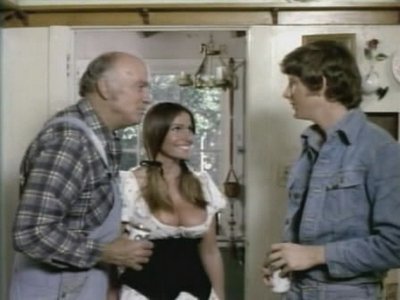
The Meyer Files #17: Up! (1976)


This might be the nastiest movie Russ Meyer ever made -- and that's including Blacksnake.

If Supervixens showed how Meyer could update his style to serve the tastes of New Hollywood, Up! is the complete opposite.

It turns out cartoonish violence is not so much fun when the blood and gore look realistic. And the way the women are treated in this movie...

Every directorial decision is so specifically wrong-headed, so completely tone deaf to most definitions of taste that it is both nauseating and hypnotising at the same time. You just cannot look away.

The story is impossible to follow, so this review is just going to be a list of lowlights.


We start with Adolf Hitler in a dungeon, getting done from behind by a man dressed like a Pilgrim while a naked Asian woman stirs a cauldron. The Hitler scene may actually be the film's best. It is so brain-searingly crazy, it sticks in the mind far longer than anything else in the movie. Hitler winds up dead in his hot tub after an unknown person drops a piranha in the water.

You might be wondering what this has to do with the movie. The answer is almost nothing.

The next couple of minutes are filled with montages of other characters enjoying each other's company while a naked woman wanders the forest and monologues about... something. I don't know. This movie makes absolutely NO SENSE.


We then meet our protagonist, played by Raven de La Croix. She looks like Kat Denning's older sister, and her performance is actually pretty similar to the Broke Girl -- aside from the nude karate.

Anyway, this is the point where the movie goes from pleasingly bizarre to actively offensive.

 Raven winds up in a town where everyone wants to have sex with her, and consent is not on the menu. Despite beating up plenty of dudes, Raven winds up attacked multiple times.

For reasons know exclusively to himself, Meyer decides to play these scenes like Looney Toons. Combining ultra-realistic violence, rape and cartoon sound effects, Up! is the one film in Meyer's canon that feels like a sleazy exploitation movie.

All of his other movies, even the darker ones, never went this far. But then again, Meyer's earlier films had to abide by the censorship practices under the Hays Code. After the Code ended in the late 60s, the gloves were off -- and Meyer decided he had to up the ante.

To wrap up the plot, the male characters wind up killing each other or getting killed by Raven, who then has to face off against the real villain of the piece (and Hitler's killer), his daughter Alice (Janet Wood).

The movie runs out of steam about 15 minutes in and it is a slog to get through.

Raven is pretty watchable, and is good with pithy one-liner. It's just too bad Meyer didn't give her another, better vehicle.

The rest of the cast is a collection of nobodies. For once, Meyer's talent for weird faces and odd characters fails him. Other than Raven and Edward Schaaf's Hitler, they are just not memorable or interesting in any way. This movie really misses the idiosyncratic charms of Mickey Fox, Stuart Lancaster and Charles Napier.


In closing, Up! is not good. If you want to see Meyer go off the deep end, you might like parts of it. Watch the Hitler stuff for some chuckles, and then switch it off.

Russ Meyer will return with Beneath The Valley Of The Ultravixens!

For previous entries...


The Meyer Files #1: The Immoral Mr. Teas (1959)


Saturday, 16 April 2016

Scorsese's picks: Murder by Contract (Irving Lerner, 1958)


I first heard about Murder by Contract from Scorsese on Scorsese, a book of interviews on the filmmaker's career. He mentioned as a movie which made a big impression with its focus on a contract killer, and odd, off-kilter visual style.  


The film is a spare, small scale thriller following a sociopath (Vince Edwards) who commences a career killing various people. He does not care why, as long as he is paid.  Accompanied by an eerie, bouncy guitar theme, the killer is a fascinating void that the filmmakers refuse to explain.


It's an interesting flick, and frustratingly hard to find. It's sad because with its blend of genre flick and nouvelle vague-esque style, this movie feels a decade ahead of its time.

As the above video notes, Scorsese took some aspects of the film on in his own work (especially the sequences in Taxi Driver (1976) where Travis Bickle (Robert DeNiro) prepares himself for his 'mission').

In many ways, with its soundtrack and mordant sense of humour, the film it most resembles is Jim Jarmusch's Ghost Dog (1999).


Edwards was a relative unknown at the time and later became a TV star in the 60s. He gives a cold, slightly ironic edge to his performance as the killer. The character is meant to be a blank slate, .and Edwards is pretty good in the part.  It's not a star-making turn, and it is not meant to be. Edwards's performance is just another cog in the overall machine, and it functions well as a part of the whole.

There is no one notable in the cast. Like Edwards, they are all functional -- which is not a criticism. It's just the material does not demand a great deal from the players. This movie is all about style and mood.

There are several impressive set pieces in the film, as Edwards goes about his work -- one in a dentist's office, and one involving a bow and arrow. The movie has a good sense of style and humour which, as I said earlier, feels ahead of its time. You can definitely see the influence of Scorsese, especially in the mix of violence and black comedy.

No spoilers. It's better if you go in knowing as little as possible. There might be a version floating around on Youtube. If you get a chance, check it out.

Scorsese's picks: Leave Her to Heaven (John M. Stahl, 1945)

This is a new feature I am going to be trying out. Scorsese is extremely vocal about the films that have influenced him, so I thought I would have a go at reviewing some of his favourite films. 

Let's jump in.


This movie is a real creep show. Shot in livid technicolour, it is the story of a femme fatale (Gene Tierney) who goes about possessing a man (Cornel Wilde) body and soul. It does not matter if she has to manipulate, maim or kill -- she'll do whatever it takes to keep her man.


Lauded as the only colour noir of the classic period, Leave Her To Heaven's story is pretty generic in retrospect, but the execution is so eye-catching it is almost beside the point.

The acting is kinda cardboard. Cornel Wilde is stoic as the gormless spouse, and Gene Tierney is alabaster -- yet somehow, their relative reticence adds to the mounting sense of dread.

Speaking of dread, check out this clip. The film is probably most famous for this scene. It really encapsulates the film's tone and style to a T.


Stone cold. Tierney has been criticised for being a bit of a blank slate in her other roles (especially her most famous role, in Otto Preminger's Laura), but it works really well here.

Tierney and Wilde may get the billing, but the star here is the Academy Award-winning photography by Leon Shamroy. The colours are so vibrant and beautiful that the rustic locales resemble the idealised America of Norman Rockwell.

Unlike other noir, there are no shadows here, and most of the major sequences take place in bright sunshine. Like Hitchcock's Vertigo or Kubrick's The Shining, the effect is very unsettling, and more effective at conveying the declining mental facilities of their protagonists.

Like its villainess, Leave Her to Heaven is beautiful to look at, but its attractive exterior is merely camouflage for the darkness underneath. Check it out.

Tuesday, 12 April 2016

RAMBLIN' RANT: One change that could have made KINGSMAN better


I liked Kingsman: The Secret Service. Didn't love it, but the things I liked about it I really liked.

My major issue with it was how beholden it felt to the old Bond formula, in one specific way which felt slightly distasteful.

My problem was that the movie ultimately ended up being about a bunch of rich old white guys (who have inherited their wealth) training a young white guy to be just like them and go kill a self-made minority character in order to maintain the status quo (which has been pretty good for rich old white guys, as we've seen recently).


I'm sure this was not the filmmaker's intention, however when the movie is all about jazzing up and 'modernising' the spy flicks of yore (your 60s-70s Bond flicks and their ilk), the adherence to the formula without major modifications just made the film feel like a note-for-note cover of an older movie.

There is one change the filmmakers could have made which might have made Kingsman considerably more interesting, and different, than its inspirations.

It's pretty simple: make Gazelle (Sofia Boutella) Eggsy.


All of Harry Hart's (Colin Firth) talk of bringing in new blood, and Eggsy's rivalry with the blue bloods during training, would have packed so much more impact if Eggsy was played by a woman of colour.

Heck, throw in the disability as well. Maybe she gets crippled in her first assignment and has to work her way back into the fold.

We've seen female heavies a million times, not to mention henchmen with weird disabilities/superpowers. Nothing new there, and having two non-white antagonists with odd deformities facing off against male WASPs with gentrified backgrounds (don't bring up Roxy, she gets almost nothing to do) is a trope that 's been with us since the days of Bulldog Drummond and Fu Manchu.

 Think of all the scenes where Eggsy has to prove himself -- all would be improved if the disjunction between Eggsy and the members of Kingsman were more pronounced. How much more rewarding would it have been if Eggsy was not an English gent? How much funnier would it be? The opportunities for really satirising the antiquated tropes of the Bond formula are endless, and sadly unexplored. Instead we get an anal sex joke.

Making the 'new addition' a young white guy, whose father was a part of the organisation, is so pat. It just highlights how old-fashioned and unadventurous Kingsman really is. While it has fun with the tropes of old-school Bond, it also replicates the underlying ideology of those films, projecting a world in which 'good' is defined as an Englishman in a suit, and 'evil' is everyone else.

Thursday, 7 April 2016

The Meyer Files #16: Supervixens! (1975)


Maybe my favorite Meyer film, 1975's Supervixens! was the movie that brought him back into the public consciousness after the disaster of Blacksnake.

It is also notable for featuring his second greatest villain. Outside of Tura Satana's glorious Varla, Charles Napier's grinning psycho Harry Sledge is the best embodiment of Meyer's deranged Neanderthal.


Like always, the plot here is simultaneously pretty simple and needlessly complicated.

After a fight with his girlfriend Angel (Shari Eubank), young stud Clint Ramsey (Charles Pitts, human cardboard) crosses paths with Sledge. Despite no real evidence, Sledge beats Clint up and warns him away from Angel (who he is pretty keen on).

Following an abortive sexual encounter with Angel, Sledge winds up killing her and frames her boyfriend for the murder.

Ramsey goes on the run through a cartoonish world of gas stations, super-stacked women and a stetson-wearing maniac named Harry.


This movie is one of the most iconic Meyer epics. It features all the usual tropes, a lot of familiar faces and some of Meyer's best directorial work. It is also bloated, repetitive and has moments of extreme boredom.


Criminally, Charles Napier is only in the opening and closing reels, and the movie could use more of him. Harry Sledge is the most terrifying, fully realised character in the movie, but Meyer deploys him too sparingly.

Instead, we are stuck with Clint Ramsey. Charles Pitts is such a non-entity you could replace him with a tumbleweed and it would be more engaging.

Meyer's female cast are cut from the usual mould, with Uschi Digard making a somewhat unsettling return as a nymphomaniacal milk maid.


There is something uncanny about Digard -- her smile is too wide, and her eyes a little too wild. If they had made a Batman movie in the 70s, Digard would have made a great Joker.

Haji and Stuart Lancaster turn up as their characters from, respectively, Good Morning and... Goodbye! and Mudhoney! Haji pops in to exchange a few insults with Ramsey, while Lancaster plays a more lascivious version of Farmer Lute, who chases Ramsey off after he catches the younger man in a compromising situation with Digard.  

On release, Supervixens! was a massive hit, and proved that Meyer could still make a hit. It is also the last fully successful movie he made. Up! and Beneath the Valley of the Ultra-Vixens would have their moments, but Supervixens! is the last time the Meyer magic is present in full strength.

Russ Meyer will return with Up!

For previous entries...


The Meyer Files #1: The Immoral Mr. Teas (1959)


The Meyer Files #15: Blacksnake (1973)


After his escape from 20th Century Fox, Russ Meyer attempted a comeback with the slave revolt epic Blacksnake.

Whatever possessed him to think an action film about slavery would work nobody knows.


The plot is fairly well developed: It's 1835. Charles (David Warbeck), a young Englishman, arrives on the English colony of St Christopher, an island in the West Indies. He is here to find out what happened to his brother Jonathan (David Prowse), who disappeared after marrying the sadistic mistress of the island, Lady Susan (Anoushka Hempel).

The story is actually rather compelling -- it's just the presentation is all wrong. The violence  (including multiple whippings and a crucifixion) is quite graphic (although rather tame today), but when combined with Bill Loose's cartoonish, melodramatic score and Meyer's penchant for random comic buttons on scenes, it results in a completely tone deaf mess.

It does not help matters that New Zealand actors Warbeck and Hempel are miscast in the leads -- Warbeck flits between comic double-takes and vengeance-fuelled rage, with no space in between; while Hempel is far too light-weight and shrill, lacking the kind of gravitas Lady Susan would need to hold over her terrified slaves.

This movie is just all kinds of wrong, and Meyer found that out when it bombed on release.

With his career stalled and his recent marriage to Edy Williams already in its death throes, Meyer knew he needed to get back to what he did best. In so doing, he would create the last of his great villains, a man with a lantern jaw called Harry Sledge...

Russ Meyer will return with Supervixens!

For previous entries...


The Meyer Files #1: The Immoral Mr. Teas (1959)


Interlude: Russ Meyer at Fox (1970-1971)

Don't worry, my next Russ Meyer review is on the way.

But first, some history.

After the blockbuster success of Vixen!, Meyer was offered a contract with Twentieth Century Fox. The big studio was in big trouble, and on the point of collapse.

Meyer came in, hired Roger Ebert(!) to write a script and together they came up with Beyond the Valley of the Dolls (1970). 


An insane 'sequel'/parody of Mark Robson's 1967 hit Valley of the Dolls,  Beyond made $20 million in the US alone and gained Meyer new critical flavour.

Meyer was at the height of his powers. And then he made The Seven Minutes (1971). 


A court room drama about censorship, The Seven Minutes was a big flop which saw Meyer leave Hollywood under a cloud. I have not seen The Seven Minutes in its entirety. It's very hard to find, but there are some extremely shoddy clips floating around Youtube. 

On the hand, I have seen Beyond, and it is one of the best comedies about Hollywood I have ever seen. 

It is the story of the Carrie Nations, an all-girl band who come to California seeking fame and fortune. Instead, they meet Z-Man (John LaZar), a Phil Spector-ish music producer, who takes over their lives and comes very close to destroying them. I have written about Z-Man before, but it is worth re-iterating just how awesome he is.


Bear in mind that have not even scratched the surface of the multitude of plot lines and characters the movie introduces (including rogue Nazi Martin Bormann as Z-Man's butler), BUT it is a testament to LaZar's performance that he manages to stand out. He is one of the highlights of the movie, and one of the most memorable characters in the Meyer rogues gallery.

Beyond the Valley of the Dolls out on Blu-ray, if you want to check it out. I highly recommend it.

Postscript: The story of Russ Meyer's work and friendship with Roger Ebert will shortly (if reports are true) be turned into a feature film starring Will Ferrell as Meyer and Josh Gad (Frozen) as Ebert.