Tuesday, 5 September 2023

Back by contractual demand: John Gardner's Death is Forever (1992)

In this season of The James Bond Cocktail Hour podcast, we are covering the six year gap between Licence to Kill and GoldenEye, covering everything James Bond-related, from books to comics to video games, to non-Bond properties which tried to fill the gap.

On the latest episode, we return to the work of hardworking Bond continuation author John Gardner with 1992's Death is Forever!


If you enjoy something I wrote, and want to support my writing, here’s a link for tips! 

Saturday, 2 September 2023

OUT NOW: Equalizer 3 (Antoine Fuqua)

Robert McCall (Denzel Washington) is back!

After equalizing a compound of bad 'uns, Robert finds himself near death and stranded in Italy.

Brought back to health by a local doctor, Robert spends his time rehabilitating his body and reconnecting with his humanity through his interactions with the town locals.


Equalizer 3 is the franchise stripped to its most essential self. Robert McCall is no action hero - he is the protagonist of a horror movie.

After two movies in which McCall was a one-man-army, executing bad guys with extreme prejudice, Equalizer 3 removes any pretence of a good time and turns into a full-on slasher movie.

There are no real action scenes - most of the violence is offscreen or executed (lol) in brief, brutal spasms.

Where the film lingers is on the effects of McCall's rampages: the opening scene is a series of long takes through a Sicilian villa, as a local gangster discovers his henchmen piled around the building in grotesque tableaux, their methods of dispatch (kitchen implements, other cutlery) betraying a disturbing familiarity (not everyone has been shot - but anyone who has sliced their finger on a kitchen knife will wince at the brutality here).

Washington's performance positions McCall as a man rediscovering himself. There is something quietly childlike in his fixations, like setting out napkins on his table, almost as if he is rediscovering the familiar routines that give him stability.

When his new calm is disturbed by a new collection of bad 'uns, Washington gives McCall a more externalised volatility - in a striking shift from the containment of his form in the previous movies, he shows himself to mafia boss Vincent (Andrea Scarduzio), wandering into a field of fire with arms loose and swinging, loudly proclaiming that they cannot disturb his newfound peace. The actor plays McCall as completely uncoiled and almost willing on his own destruction.

It is not a new signature role, but as his final turn as an established character, it makes for a fascinating juxtaposition with the previous movies.

Outside of its conception of the central character, Equalizer 3 is a little too familiar. It is another story of a bad man seeking redemption by protecting innocents from harm. The villains are uninteresting, Dakota Fanning is a little underserved as McCall's sidekick. 

On the latter count, her role is so minor, one almost hopes there is a fourth film in which they can work together.

If you are in the bag for big screen Equalizing, you might get something out of it. I think it is best served as the third in a marathon. 

Related


If you enjoy something I wrote, and want to support my writing, here’s a link for tips!

Tuesday, 22 August 2023

Freddie as F.R.O.7 (Jon Acevski, 1992)

In this season of The James Bond Cocktail Hour podcast, we are covering the six year gap between Licence to Kill and GoldenEye, covering everything James Bond-related, from books to comics to video games, to non-Bond properties which tried to fill the gap.

On the latest episode, we enter the world of big-screen animation with 1992's Freddie as F.R.O.7!


Sunday, 20 August 2023

NZIFF 2023: Inside (Vasilis Katsoupis, 2023)

Nemo (Willem Dafoe) is an art thief.

On his latest job, Nemo finds himself sealed inside a hi-tech penthouse apartment.


Without food or water, and with no escape route, Nemo is trapped.


The locked-room thriller is one of my favourite genres - there is something about the limitations of the setting - and the focus it can give to characters in a specific world - which gets me excited.
 
Inside takes the limitations of the sub-genre to the next level. 

What starts out as a heist thriller about a high-end art thief turns into a movie about a contemporary man reduced/stripped to pure survival instinct.
 
As time passes, he converts the futuristic apartment into a primitive dwelling - where food, water and refuse take precedence.

As his escape attempts become more sophisticated, so do Nemo’s artistic instincts. At first, Nemo's focus is primal - get food and water.

As a survival thriller, it is effective as an urban take on Castaway - Nemo has to improvise solutions to problems, from dealing with the apartment’s blaring alarm, to securing a water supply, to his evolving attempts to escape his prison.

The film is fundamentally about the importance of art to the human condition. No matter how difficult the terrain, we still need art, the power to imagine (and hope) in order to keep going.

Nemo starts drawing on the wall, creating out of despair and hope. As his escape attempt grows in complexity, it begins to resemble a giant art installation of found objects and the unseen owner's art collection.

As the only character on screen, Dafoe is magnificent.

His is a singular presence, hanging somewhere between desperation to overcome, and a berzerk sense of forward momentum.

Because he plays it so earnestly, the film’s ironies work. A more overtly self-aware performance would have exposed the film’s fairly obvious themes.

In Inside, art is not just something to be acquired. It is meant to be studied, used and - perhaps most sacrilegiously - destroyed and remade into new art.

Fascinating.

If you enjoy something I wrote, and want to support my writing, here’s a link for tips!

Saturday, 19 August 2023

Sahara (Zoltan Korda, 1943)

Following defeat in the desert, Sgt. Joe Gunn (Humphrey Bogart) leads a group of survivors across the Sahara back toward Alexandria.


Arriving at an oasis, the survivors find themselves under siege by a larger German unit who want to secure the precious source of water for an advance on Egypt.


Can Joe and the others hold them off?


Maybe it was the bad aftertaste of Across the Pacific. Maybe it was the heavy signalling of the ideological conflicts of the WW2 epic. Whatever it was, it took awhile for me to warm up to Sahara.


It is a WW2 movie made and released during WW2, which makes it more interesting. This is made for a wartime audience as a moral booster, so there are certain elements that feel a tad obvious: the characters break down into a cross-section of different participants in the conflict. The German pilot they capture (Kurt Kreuger) is pure evil, a duplicitous killer who refuses to accept his fate. He is contrasted with the Italian prisoner, J. Carrol Naish’s Giuseppe, who is given a family, and eventually sacrifices himself for his new friends. 


There is a slight melodramatic undercurrent to the character dynamics, but that is just a feature - the characters might be archetypes, but they are all solidly constructed, and well-played.


Once the film turns into a siege narrative, we have spent enough time with these characters that their actions (and deaths) carry real weight.


While Bogart is reliably taciturn as the reluctant leader, the real standout is Louis Mercier as Jean Leroux, "Frenchie". He brings a charisma and humour that - while it works for this movie - felt like a tip toward the men-on-a-mission adventure ensembles of the sixties.


The film is well-photographed by Rudolph Maté, highlighting the actors’ burned, exhausted faces.


Directed by Zoltan Korda (brother of British writer-producer Alexander Korda), Sahara is more nuanced than it initially appears - the desert is unforgiving to everyone in the movie. The Germans are the antagonists, but by the end of the film, they are presented as pitifully human - crumpled against the sand, blearily staring at our heroes’ fortifications while the cries of their wounded fill dead air.


Sahara is probably the secret gem of the festival. An effective war picture more than a Bogart showcase, it is worth a look.

BONDIFICATING: The gift of Bond’s death

 
It has been awhile since I wrote one of these.

There is this feeling from some corners that Bond’s death in No Time To Die was a selfish act on the part of Daniel Craig.

Exactly how has never been made clear: selfish for killing a fictional character? Selfish for breaking from some vague idea of formula? For having creative input into the movie?

I have seen this idea running around the online fandom, and I wanted to offer a rebuttal.

Bond dying is not a selfish act. Instead it should be seen as a gift.

Craig and his collaborators wiped the slate clean. 

What an opportunity for new filmmakers! They are not forced to honour some kind of continuity or tone or expectation.

And a new actor has the space to craft their own interpretation of Bond, one that (hopefully) can stand apart from Craig.

One cannot predict where the franchise will go from here, but I want people to reflect on the potential of Bond 26.

The latest season of the James Bond Cocktail Hour podcast is out now!


Links to all of this season's episodes are below:

Sunday, 13 August 2023

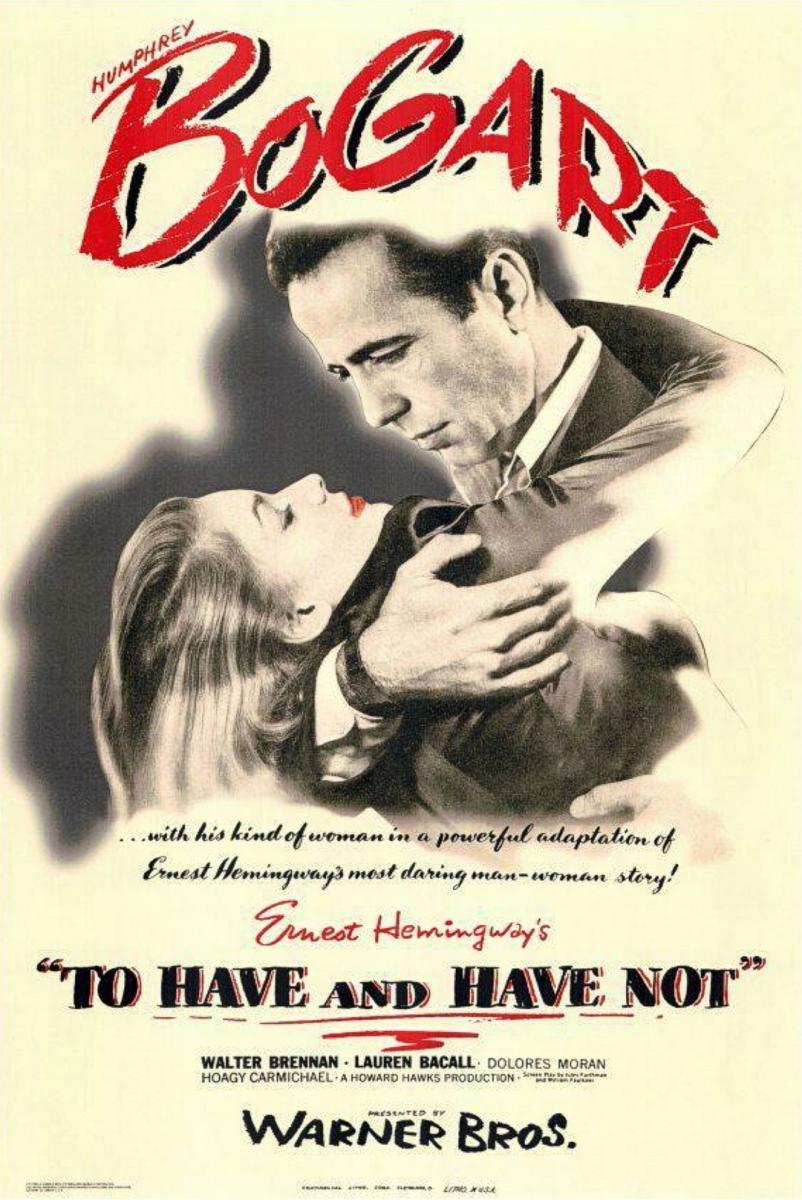
To Have and Have Not (Howard Hawks, 1944)

 In 1940, Martinique is a French colony. Since the fall of France to the Nazis, the colony is under the control of the collaborationist Vichy administration. 

Captain Harry Morgan and his friend Eddie run a fishing boat out of Fort-de-France, the island’s main port. The port is also a hotbed of violence as the Vichy officials battle with rebels who support the French French and the Allies.


Harry tries to remain neutral, but he finds his status harder to maintain when economic hardship forces him to accept a fee to get French resistance fighters onto the island.


As he romances an American stranger, Slim (Lauren Bacall), Harry is drawn deeper into the war effort.


Can he survive?


Proof that a movie featuring a small cast talking in a hotel can be exciting, To Have and Have Not is easily one of the best movies in the festival. 


While there are similarities to Casablanca - as there have been with the other films in the Academy’s schedule - To Have and Have Not stands out.


Like the 1942 film, the dynamics of friendship, love, and loyalty are key to the film’s action and suspense. 


The introduction of Lauren Bacall adds a welcome addition of sex to the familiar romance. The catalyst for the duo’s legendary on and offscreen relationship, Bacall’s chemistry with Bogart is palpable throughout.


Set in 1940 but released four years later, the film is a parable for America’s position between the Allies and the Axis at the outset of the war. Harry Morgan is a professional who minds his business and tries to keep out of the spheres of either the Vichy authorities or the rebels trying to unseat them.


This movie is great, but watching it after Sirocco highlighted its strengths. This movie is less interesting for its plot than its focus on the relationships between the characters - and how the pressure of outside forces brings out their true selves.


Unlike Bergman’s angelic Ilsa, Bacall’s Slim is a born schemer -  she has had to find her own way in the world, and bears no guilt or divided loyalties. She also sees through hypocrisy and personas, sizing up Harry as soon as they catch sight of one another.


In a neat reversal, it is Bogart who is the object of desire - although Bacall’s performance ensures this view is imbued with a little more lust than Rick’s.  


Most of the film’s action takes place in tight interiors - or interiors rendered claustrophobic by crowds of people. There is a constant sense of surveillance, and of benign under siege. There is also a sense of community, of the bustle of everyday life, of people finding solidarity, joy and romance together.


On  paper, To Have and Have Not might come across as stagey, but the finished film has the pace and dynamism of an action movie - except the characters trade barbs instead of bullets.


There is a subset of movies which I love where the world of the movie is so vivid, you would want to hang out and marinate in the ambience. To Have and Have Not is now one of those movies.


I wish I had caught it sooner.


Related 


Across The Pacific 


Tokyo Joe


Sirocco 


The African Queen


Beat the Devil


If you enjoy something I wrote, and want to support my writing, here’s a link for tips!