Monday, 30 December 2024

The Mark of Zorro (Rouben Mamoulian, 1940)

Don Diego Vega (Tyrone Power) returns home to California to discover his home under the thumb of a corrupt magistrate Don Luis Quintero (J. Edward Bromberg) and his violent enforcer Captain Esteban Pasquale (Basil Rathbone).


Disturbed by the plight of the people, Don Diego adopts the masked moniker of Zorro to strike back and bring down the regime…


A week or so ago, I finally watched The Adventures of Robin Hood. The movie is great, I will probably scribble something about it, but more importantly it reintroduced me to a genre I had not watched since I was a child:


The swashbuckler. 


Robin Hood aside, most swashbucklers involve pirates and sailing ships. One of the other exceptions is Mark of Zorro.


Like Adventures of Robin Hood, Mark of Zorro is technically a remake of a silent original, starring the original American action star Douglas Fairbanks.


Despite its origins, The Mark of Zorro is a movie with a long shadow. Well-regarded since its release, it is often held up as one of the finest adventure films ever made.


It has been referenced both overtly - The Mask of Zorro feels like a loving sequel - and in more subtle ways (Batman fans will recognise it as the movie that young Bruce Wayne watches the night his parents died).


With its story of a nobleman moonlighting as a masked avenger, righting wrongs, it is easy to see the inspiration for the caped crusader. It also feels a lot like Robin Hood.


Watching this movie after The Adventures of Robin Hood made the viewing experience slightly surreal as it shares that film’s villain (Basil Rathbone) and Friar Tuck (Eugene Palette). It was like going into the remake right after watching the original.


Tyrone Power was an idol of the 40s and 50s. I have heard of him but this is the first movie of his I have seen.


Like Errol Flynn, he made a name for himself in swashbucklers, but then made the transition to the stage and more dramatic roles. He famously passed away of a heart attack while filming a sword fight for Solomon and Sheba.


He is an interesting contrast to Flynn.


Flynn feels chaotic, with a devil-may-care attitude and sexual charisma to burn.


Power is positively conservative by comparison. He is equally athletic, but comes with a pedigree. If Flynn feels like a man of the people, Power feels more blue blood.


He may romance Linda Darnell but his intentions seem completely wholesome.


When Flynn’s Robin Hood whisks Olivia De Havilland’s Maid Marion away at the end, it feels like they are about to have a different kind of climax.


Power is a joy, playing up the foppishness of his public persona but without going too broad. He appears more as a disconnected nepo baby, uncomfortable with even the vaguest inconvenience. It is totally believable that his foes dismiss him.


Earlier, I referenced the familiarity of the supporting cast.


It is a good example of how the studio system worked, taking character actors known for playing a specific type and plugging them into similar roles. Hence why you have Eugene Palette essentially playing Friar Tuck (completely with sword fight) and why you have Basil Rathbone playing a variation of Guy of Gisborne. 


Rathbone also came with the pedigree of being a trained swordsman. 


Something I have picked up on in my own enjoyment of action movies (or movies driven by action, like musicals) is when characters show physical ability through casual behaviour: Rathbone’s stretch as he prepares to duel Power is not a subtle example but conveys experience and the character’s casual sadism - this is a man who sees death as a sport.


While Rathbone is great, J. Edward Bromberg is the most interesting of Zorro’s antagonists as Don Luis Quintero, the corrupt mayor of Los Angeles.


Self-serving and cowardly, he is willing to throw anyone under the bus. He is also one of the comic highlights of the movie. His final speech, in which he informs the townsfolk that he intends to retire, is a delightful series of increasingly morose proclamations as the audience voices their displeasure with jeers and laughter.


While I have loved diving into the swashbucklers, one recurring issue is how poor the women’s’ roles are in these movies.


And that extends to The Mark of Zorro. While the other elements of the film feel like they are punching above their weight, the romance is a bit prosaic.


Linda Darnell does not get much to do but look beautiful and provide a reason for our hero to realise living in California is not so bad after all. Her one real scene - confessing her desires to Zorro, disguised as a priest - is a comic highlight, but she is basically serving as an unknowing straight man


While watching Robin Hood and the other swashbucklers, I was struck by the unity of their underlying disdain for the greed of the landed gentry. Even the heroes come from the same class, they recognise the inequalities of the world around them, and the films are about our heroes finding various ways to redistribute their wealthy victims’ resources.


Most of these movies were made during the Great Depression, and it feels a part of the text in Mark of Zorro. 


One of the most striking elements is how grim Los Angeles county is in the eraly parts of the movie. Maybe it is the effect of being shot in black and white, but the movie takes its time to show the brutality of the new regime.


This sequence starts as a case of mistaken identity - Don Diego introduces himself as the son of the Alcalde (magistrate) of the county, ignorant of the fact that his father has been forced from office.


He learns of the new state of the people as a stranger. While coming from a high status background, the film positions Don Diego as an outsider, and someone that everyone underestimates.


What is fascinating about the movie from a contemporary perspective is how unfussy the movie is about its title character. We get motivation for why Diego becomes Zorro, and that is it. We do not get any sweaty scenes showing our hero putting together his vigilante persona and costume. 


Zorro is introduced with speed - riding on his horse and publicising his goal with a poster (like Batman, he understands the power of branding).


The final sword fight in The Adventures of Robin Hood is fantastic - this one is even better.


It helps that the characters in-movie are trained swordsmen (there is a great bear where Rathbone actually stretches before the duel).


Trading barbs and blades around an office, the pair’s battle is also one over the privileges afforded by the landed gentry.


There are few action sequences in the picture but it moves at a clip (only 94 minutes!) and makes up for it with a fantastic final duel and pitched battle.  


Maybe because of the parallels with Batman, I was surprised at how closed the ending is. 


Our hero has saved the people and found love.


The movie’s character arc is simple - he starts the movie as a soldier, excited to be at the centre of the action.He treats his return home as purgatory


By the end of the film, he has found purpose and contentment with matrimony.


Order has been restored - the corrupt ruler has been replaced by a more benevolent one, all classes seemingly united. Going back to the contemporary context of the film’s making, it feels like an allegory for Roosevelt’s America; not remaking the old order but re-working it to a more egalitarian model


The film had no sequels, although it paved the way for Power to challenge Errol Flynn as a swashbuckling hero.


It made me want more Zorro, but it also made me want to check out more movies in the swashbuckler genre.


Check back in - the Midnight Ramble will be swashing more buckles shortly.


Related


If you enjoy something I wrote, and want to support my writing, here’s a link for tips! 

Saturday, 28 December 2024

Uh Oh Seven: Blackbird (Michael Flatley, 2022)

In this season of The James Bond Cocktail Hour podcast, we are covering the six year gap between Licence to Kill and GoldenEye, covering everything James Bond-related, from books to comics to video games, to non-Bond properties which tried to fill the gap.


We finish 2024 with the blockbuster of 2018-no, 2022, Michael Flatley’s magnum oopus, Blackbird!

Check out the episode at the link below:


Edge of Darkness: Compassionate Leave

Edge of Darkness: Into the Shadows

Edge of Darkness: Burden of Proof

Edge of Darkness: Breakthrough

Edge of Darkness: Northmoor 

Edge of Darkness: Fusion


If you enjoy something I wrote, and want to support my writing, here’s a link for tips!   

Wednesday, 25 December 2024

Hitman (Richard Linklater, 2023)

Gary Johnson (Glen Powell) is a philosophy professor at a community college who moonlights for local law enforcement, helping to catch people who are trying to hire a hitman.


Forced into playing the role by circumstance, Gary finds himself enjoying the escape into a different persona.


When he finds himself attracted to a would-be client, Madison (Adria Arjona), Gary finds his part-time job turning into a full-time problem…


“So what do you do?”


A movie designed to make Glen Powell a movie star.


In another era it might have done the trick. We shall see how its Netflix release will help or hinder Powell.


This is a movie with dynamite chemistry between the leads. Powell is great but he is matched by Arjona as Madison.


The way she conveys Madison’s mixture of terror and titillation at the idea of “Ron” and his world is key to the film’s success.


That ambiguity pays dividends on initial viewing. The film is from Gary’s point-of-view so it is easy to read Arjona/Madison’s excitement as a black widow toying with her latest victim, rather than a sheltered neophyte breaking out of what society expects of her. 


It does feel like both characters are played by people way more good-looking than the script is trying to convey, but it does not matter when the chemistry is this strong.


This movie is so sexy. It felt like a throwback to movies like Out of Sight, and every other movie about charismatic people making bedroom eyes that Hollywood gave up on.


It is also  great to watch a movie with a couple who have a totally solid relationship dynamic built on a foundation of lies and murder. 


Informed by the impression that each of the partners is secretly a murderer, Gary and Madison’s attraction seems to be partially based on danger.


It is the dynamic of an erotic thriller, or a Bond movie. Instead, it is the basis of a romantic comedy. While it seems offbeat at first, how many romantic comedies are based on one of the parties lying? Too many to list!


They are people who find themselves and each other by creating alternative roles - roles which begin to bleed into their regular personalities.


One of the best scenes in the movie - and the one where they fall deeper in love with each other - is when they have to roleplay a ‘confrontation’ for Gary’s police handlers.


Following the film’s lowest moment - in which Gary finally bears all (“Who the fuck is Gary?” might be the funniest line in the movie) - this scene underlines the film’s thesis about public faces, and they can both reflect and project our deeper desires.


And unlike a more traditional treatment of this idea - where our heroes would be punished for their deceit - Hit Man validates their role play. 


Both Gary and Madison start the movie as insular and closed off (although her plight is more explicit and threatening), but by the end of the movie they are strong enough to take control of their lives and find happiness.


It does feel like both characters are played by people way more good-looking than the script is trying to convey, but it does not matter when the chemistry is this strong.


The tone is light and frothy, Powell has fun as the various hit personae (shout out to the Tilda Swinton-inspired wordsmith), and the film earns its cozy domestic close.


If you enjoy something I wrote, and want to support my writing, here’s a link for tips! 

Monday, 16 December 2024

Twisters (Lee Isaac Chung, 2024)

A group of storm chasers attempt to track twisters with a new form of technology.


Is it 1996 all over again?


Twister is a totally fine movie.


Helen Hunt, and her character’s motivation, give the 1996 picture a pathos that Twisters cannot quite match.


And while the CG might seem a little dated, the film has a focus on special effects that increases the sense of stakes. The physical effects, sets and location work to give the movie a verisimilitude that the spare use of CGI cannot.


The story is almost too simple, but the characters are clearly defined and the scope is just big enough. We get a couple of different locations but we spend time in them. The film does not get lost in trying to show viewer twisters destroying cities.


There is a sense of awe and respect for twisters as unique and terrifying natural forces.


I had not watched it in years, maybe decades.


I remember watching it on video around the time Titanic came out, and being doubly traumatised by the boat sinking and Helen Hunt’s dad getting sucked away.


Going into Twisters, I had no idea how much of a legacy sequel this movie was going to be.


What is oddly refreshing about it is that it feels more like a traditional sequel.


It does not share any cast members or story threads, but it is a rough facsimile of the original film: a central character gets a tragic backstory and an arc, there is the rival team of storm chasers, and there is a final test to prove both the durability of the technology (and the central couple’s romance).


The cast are fun - I loved seeing Sasha Lane and Katy O’Brian as a part of Glen Powell’s crew.


None of the set-pieces are that tense. I had a good experience but had a hard time remembering any of it.


The best compliment I can give the sequel is that it recognises and takes the right lessons from its predecessor.


The scale stays relatively the same. The cast is more diverse and also smaller - the first movie featured way more supporting players than I could follow.


It was also nice to see a blockbuster about ordinary people. It is shocking to think about how rare that is nowadays.


It is too early to judge (the film was a decent hit in the States but did little business overseas) but hopefully Twisters is a sign that audiences are interested in seeing films like this.


I am agnostic on a Twister 3, but with the decline of the superhero genre over the last couple years, perhaps we will see more large-scale genre movies about ordinary people dealing with extreme but (relatively) real-world obstacles. 


If you enjoy something I wrote, and want to support my writing, here’s a link for tips! 

BITE-SIZED: Turnabout (Hal Roach, 1940)

When a couple (John Hubbard and Carole Landis) find themselves swapping bodies, they see it as a chance to experience how the other half lives.


One of the earliest body swap comedies, Turnabout is also a key text in showing the shift away from screwball comedies to more slapstick, broader comedic forms of the war years.


Since it is basically the original version of this premise, the film takes its time to set it out.


The first half of the movie lays out the world of the central couple, essentially providing an extended set up for the central joke.


Their characters are broad and designed to fit stereotypes of traditional gender roles: Tim goes to work; he is dynamic and athletic; Sally is pampered and stationary (she is introduced trying to sleep in).


The film was something of a culture shock. My knowledge of comedy from this era is most through screwball comedies, where the active role is generally taken by a woman who upends the man’s conventional life. 


Landis and Hubbard seem to be having a great time as their gender-flipped selves. The effect is somewhat muffled by the decision to dub the characters with their original voices.


We get plenty of farcical hijinks as our unhappy couple realise they are not made for each others’ lives. 


The movie ends with all restored thanks to the declaration of a baby. This supposed return of the old order is undermined when it is revealed that Tim is the one who is expecting.


Released a year before US had entered World War 2, there is some added irony to Turnabout’s final gag, anticipating the rapid shift in gender roles as the economy shifted to a war footing.


I watched the film by myself online, so I cannot speak to how funny it is with an audience, but it is fascinating as a historical document.

Saturday, 7 December 2024

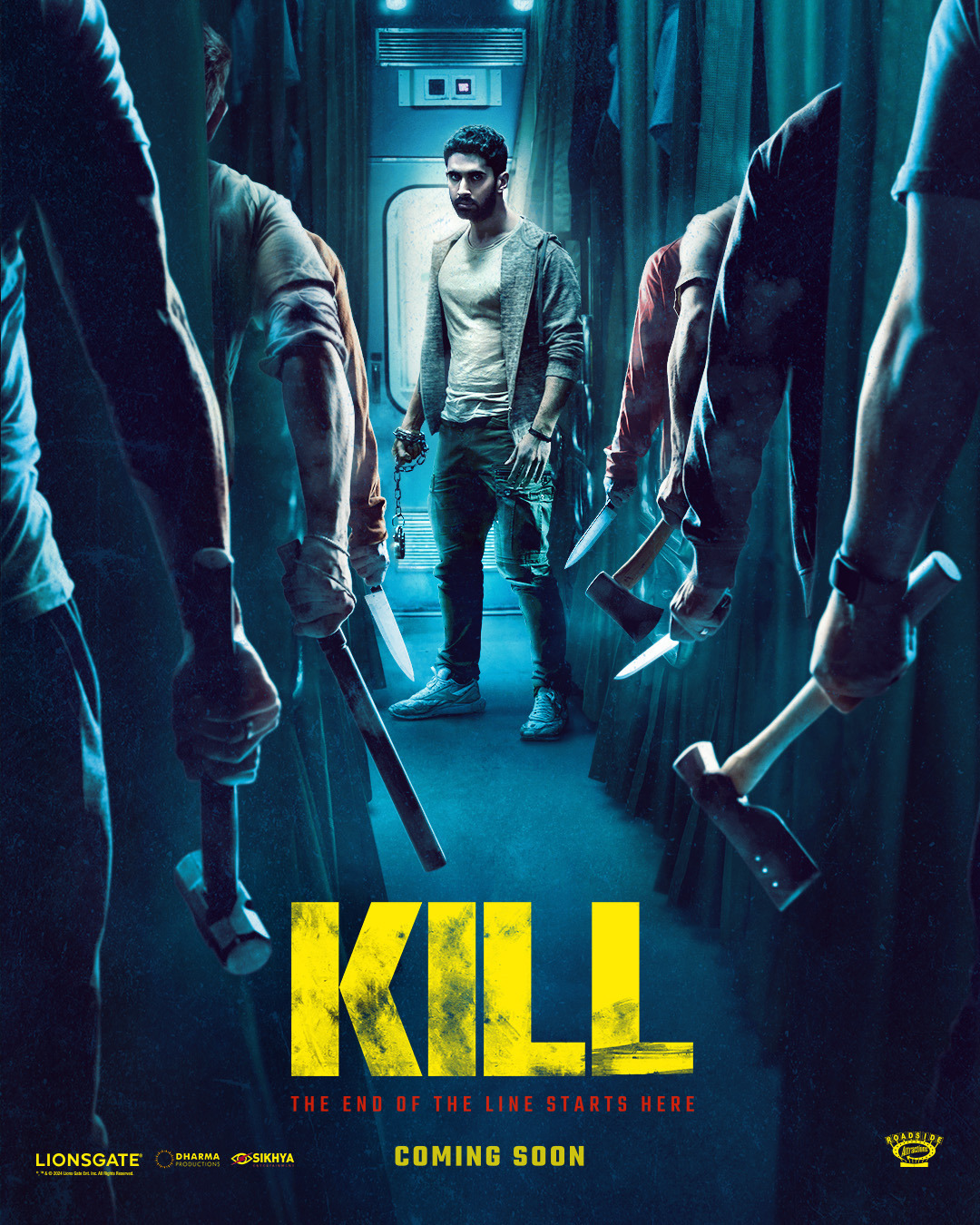
Kill (Nikhil Nagesh Bhat, 2023)

 After his girlfriend Tulika (Tanya Maniktala) is engaged to another man, commando Amrit (Lakshya) arrives at the engagement party to try and convince her to break it off. He fails.

Both lovers end up on the same train home, and Tulika accepts Amrit’s marriage proposal.


This bliss is disrupted when bandits take over the train, and a fatal turn lead Amrit to turn his lethal skills on the attackers…


I like movies set in a single location. I love action movies set in single locations. And if said location is a train???


Kill is the latest addition to this subgenre - and it’s a good one.


This movie manages to pull off something that I generally fight against in these kinds of high concept action movies.


It manages to juggle multiple plot and character threads without losing a sense of pace or the focus of the story.


Ideed, I faulted the last attempt at a movie like this, Bullet Train, because it was crowded with too many characters and flashbacks.


The film spends almost equal time with the bandits, who are shown to be family.


Rather than faceless henchmen to be run into the fists and feet of our hero, they take up half of the narrative space.


Their motivations push the narrative forward as much as our heroes’.


They are an irresistible force meeting the immovable object.


45 minutes in the film turns the knife, and hits us with the film’s title card, and it gains - if not a new meaning - a turbo-charge of emotion.


After this brutal punctuation, the film flips from an action film to a revenge thriller.


In the lead role, Lakshya manages to handle this switch without missing a beat.


A great physical presence, he is convincing in the action sequences as both a put-upon underdog hero struggling against the odds, and as a focused killing machine. He also has a highly expressive face, lending a humanity to what could have just been a rote action hero.


Even after the villain’s actions trigger our hero’s transformation, the filmmakers continue to track them. 


Action movies are based on a justification for violence.


It is a testament to this film’s sense of dramatic focus that our hero feels totally justified in turning his opponents into spaghetti bolognese while we continue to track the deteriorating dynamic between the villain and his uncle/boss.


The blurred line between the one-man action and slasher horror genres is completely destroyed.


I wish I had got to watch this movie in theatres. 


If you are new to this blog, I also co-host a podcast on James Bond, The James Bond Cocktail Hour. 

You can subscribe on Apple Podcasts, or wherever you get your podcasts.