Sunday, 4 August 2019

IN THEATRES: Hobbs & Shaw

Luke Hobbs (Dwayne Johnson) and Deckard Shaw (Jason Statham) are brought together to track down a double agent who has stolen a virus with the potential to wipe out the human race. The assignment gets personal when Shaw discovers their target is his sister (Vanessa Kirby), and the real bad guy is a super-powered assassin Brixton (Idris Elba).


In a race against time, Hobbs and Shaw have to learn to work together in order to save the world.


This movie is like getting to eat a plate of my two favourite ice creams for dinner. I liked it at first but then the plate is empty and I’m sunk in my seat regretting my own indulgence. I missed the rest of the ensemble - especially Tyrese (a phrase I thought I would never say).

Apart from their fighting styles, there is no real difference between our heroes. Hobbs is a tough guy one-liner machine; Shaw is a tough guy one-liner machine. Their conflict amounts to a dick-measuring contest, with Shaw's sister the unsuspecting battleground.

If I was to compare this movie with anything, it feels like a more polished Tango and Cash, with two superficially mis-matched leads who really are not that different.

I can barely remember anything in these movies but I was actually wondering if the movie was going to finally deal with the fact that Shaw killed longtime family-member Han (Sung Kang) - it would have been something.


This movie really crystallised how uninteresting - in 2019 - Johnson and Statham playing into their established personas is. In the ensemble format of the previous Fast movies, their antics feel special: in a 160(!) minute movie, it feels tired.  

Beyond this, both actors have proved themselves to be far more interesting when they are playing against type (most recently, Johnson's creepy re-working of his A1 persona in Central Intelligence; Statham's outright parody of his filmography in Spy). In Hobbs and Shaw, we are presented with the broadest, simplest images of its stars. Shorn of its parent franchise's style and ethos, it would have been interesting to see this movie define itself as a self-sustaining entity.

And now onto the self-proclaimed bad guy.


I felt bad for Elba. Once again, he is stuck playing another generic role. He is a great actor who is frankly far better than this kind of cookie-cutter nonsense. The only moment that felt like something new was his little chuckle when he realises he has been abandoned by his paymasters.  

One thing that I always liked about the previous Fast movies is that they never seem to plan ahead. This is the first one where we are promised a bigger baddie. It undermines Brixton, who just becomes a lackey for a bigger villain we never get to see.

The set pieces are pretty good, although the film never really capitalises on having a villain who is "Black Superman". Johnson and Statham are already hyperbolic action heroes and the movie never really delineates between the skills of heroes and villain to give their various confrontations any sense of stakes. 


Vanessa Kirby is really good - the script is smart enough to never turn her into a damsel in distress. She manages to get herself out of every situation she is in, although there are a few moments (such as the scene where she is leaping from roof to roof in the bad guy's underground base) where she shares her co-stars' aversion to physics (which in turn makes Elba's bad guy even less impressive).

In a more retrograde move (that really reminded me of Messers Tango and Cash), part of the title pair's enmity comes from Shaw's belief that Hobbs has eyes on his sister. Thankfully the movie soft-pedals this maybe-attraction. Maybe because their antagonism seems so sexual, this subplot comes off as gross. Hopefully this is completely ignored in the probable sequel.
Hobbs and Shaw is a serviceable enough popcorn flick, but it feels like the law of diminishing returns is catching up with the Fast and Furious franchise.

If you are new to this blog, I also co-host a podcast on the British girl group the Sugababes, cleverly entitled SugaBros

You can subscribe on iTunes, Spotify, or wherever you get your podcasts!

Wednesday, 24 July 2019

IN THEATRES: Crawl

While a Category 5 hurricane rages outside, a young woman attempts to protect her father from a pack of hungry alligators who have taken over their flooded neighbourhood.


Watching Crawl, it felt like I was watching a cinematic rebuttal of last year's The Meg: small-scale where The Meg sprawled; deadly earnest where The Meg coated everything in faux irony; and more brutal in showing the danger its scaly antagonists pose.

Directed by French horror alum Alexandre Aja (High Tension, The Hills Have Eyes remake), Crawl is my kind of genre flick: a simple concept; a claustrophobic location; and most importantly, a willingness to put its main characters through absolute hell.

It is such a perfect example of this kind of small-scale genre filmmaking that - if it were not for the CG gators - I would have thought this was a b-thriller from the 70s or 80s. 

The main characters (played by Kaya Scodelario and Barry Pepper) are straightforward, and their conflict -resolved in a key moment before the climax - somewhat predictable. But that is part of the fun.

To give the movie some more juice, we get a couple boatloads of minor characters to give the gators a bodycount. 
The creature effects are pretty good - the gore looks mostly practical and Aja keeps the CG monsters in the shadows and under the water, which gives them more weight. 

Setting most of the movie in the house's flooded basement is a brilliant decision that adds to the movie on a couple levels: one, it traps our heroes, two, it gives the movie ticking clock as the flood waters from the storm slowly rise. Finally, it helps to hide the CG monsters with shadows and under the water. If this movie took place in daylight, the effects would look terrible. Aja does not hang the entire affect of his movie on them, and gives the creatures more weight.

If I have one criticism, it's around injuries. Our heroine gets bitten a couple of times, but after the first injury there is little affect to her ability to perform physical tasks. I watched this movie after taking a pretty bad tumble down some concrete stairs and I was walking like an old man for a couple days. I will chalk it up to adrenaline, but it did start feel a little repetitive. 

One thing I did not expect, was how the movie re-wrote a familiar character turn: as somebody who watches a lot of action and disaster movies, one character turn that always turns up is the dad no-one respects who ends up proving to be totally right and accepted by his family at the end. Instead, the big turn here is Dave (Pepper) telling Haley (Scodelario) that his marital split was not her fault, they just don't love each other any more. He even says his wife did nothing wrong and deserves to be happy with her new partner. It is a small moment, but in a movie that is enjoyably cookie cutter, a welcome swerve.

Crawl has not been dealt the best cards at the box office. It will probably become a streaming perennial, but if you - like me - enjoy smaller genre efforts like this, buy a ticket and take your family to see it this weekend (Someone took their baby into the screening I was at, which made for some very interesting commentary).

If you are new to this blog, I also co-host a podcast on the British girl group the Sugababes, cleverly entitled SugaBros

You can subscribe on iTunes, Spotify, or wherever you get your podcasts!

Tuesday, 23 July 2019

REDUX: Little Woods (Nia DaCosta, 2018)

On probation for smuggling medicine over the Canadian border, Ollie's (Tessa Thompson) problems are piling up: her mother's house is being foreclosed and her sister Deb (Lily James) is pregnant.

With time short, Ollie goes back in to business, putting her on a collision course with a rival drug dealer, Bill (Luke Kirby) and the law...


Little Woods was one of the highlights of last year's NZ International Film Festival. When it finally made its way to general release a couple months ago, checked it out again. After the formless dreck of Tessa Thompson's last vehicle, this was a real palette cleanser.

Re-watching Little Woods made me really appreciate the craft of writer-director Nia DaCosta.

This movie is so economical. The movie is filled with moments like this - none of the film's stylistic choices are that overt. 

The opening sequence is a marvel; Thompson is shot in a long shot coming from the woods onto a road. As she moves into the middle ground, the camera pulls out the famous pull out-zoom in (from Vertigo, although DiCosta uses it to similar effect to Spielberg in Jaws) as a police vehicle speeds past her and pulls up behind her.

As Thompson runs into close-up, we hear the hard hammering of what sounds like the judge’s gavel, passing sentence on Ollie. Cue a hard cut to Ollie waking up to someone hammering on her door.

In a few minutes the film has brought the viewer up to speed on Ollie, and set up the laser focus of both its story-telling and the mindset of its central character. There is a strong sense of functionality to the story-telling, which keys in the viewer to the world that these characters live in. Ollie does not have time for contemplation or luxury. She has to move forward or die.

One of my (other) favourite sequences is in the diner when Ollie is interviewing for a job out of state. Bill arrives, having sniffed out that Ollie is back selling meds. 

Initially we do not even see him - DaCosta plays his arrival on a tight OTS shot of Thompson's face, with the sound of a door and her eyes snapping to focus on a point over the interviewer's shoulder.

In an extended tracking shot along the diner booths, we follow Bill as he storms toward the table. Ollie excuses herself just before he arrives and heads down the line of tables, so they appear to walking in lock step with each other. DaCosta does not over-use editing - she lets scenes play out. This tracking shot works to show Ollie's adaptability, as she shifts gears from anxious interviewee to cool professional, matching Bill's stride as she heads off Bill's attempt to dominate the scene.  

When there are cuts, they signal important shifts in power: in the following scene, Bill confronts Ollie in the bathroom. Ollie tries to defuse the drug dealer but Bill grabs her by the throat and slams her against the wall. DaCosta cuts here to a tight two-shot of the characters face-to-face. When Bill threatens Ollie, and demands a cut of her earnings, DaCosta cuts from the two shot to an ever-so-slightly low angle close up of Luke Kirby's face. When the filmmakers cut back to Ollie, it is back in the same two-shot as before. Ollie has lost this struggle.  

In my last review I focused on the film’s association with noir; on this viewing the film felt even more like a western - albeit one in which the frontier is gone, and all the mythology of exceptionalism and progress has evaporated.


On this watch, I was struck by how much Thompson's Ollie reminded me of a classic western archetype - the no-nonsense man of action, with a personal code and a past of misdeeds. No matter the setback or obstacle, she has to move forward. Like the gunslingers of so many westerns, people expect her to do the dirty deed - in this case, run and sell drugs, that she has given up on. However, circumstances dictate that Ollie has to 'get back in the saddle'.

Even the way Deb describes Ollie is all about action - she is called ‘practical’ and a ‘doer’. But the movie highlights the difference with the archetype: while she is an incredibly active and forceful presence in the movie's narrative, Ollie is not physically imposing - there are two physical altercations in the movie (one which she initiates) and both of which she loses. In this universe violence is not a vehicle for character or narrative progression.

Like that archetype, Ollie is also defined as an outsider - she is a woman in a world of men (I remember an old John Oliver segment that explained the ratio was 2:1 in North Dakota), and a black woman in a world of white people. The only other person of colour is Ollie's parole officer Carter (Lance Reddick), someone whose ideological and professional role makes him an (unknowing) adversary. Ollie is alone.


Despite her loner status, Ollie is also defined in terms of her relationship with/juxtaposition to her sister Deb (James). Deb is initially presented as the opposite of  Ollie - while Ollie looked after their dying mother, and lives in the family home, Deb is a single mother living in a trailer park. She is presented as a more passive presence, and in contrast to Ollie, never thinks ahead - a trait which leads to the film's biggest narrative turn.

While Ollie's race is never openly acknowledged, it provides the subtext to a terrifying sequence towards the film's end: while her sister is getting a forged Canadian health card, Ollie waits outside a bar. Framed in the foreground of a wide shot, Thompson looks small and vulnerable. In the far background, the door to the bar opens, and the familiar shape of a policeman's hat appears under the entrance light. A police officer steps out, stands for a beat and then turns to face Ollie. It reminded me of the way John Carpenter presents the Shape in Halloween

The sequence is one of the film's highlights - DaCosta intercuts Ollie's interactions with this cop with Deb and the two forgers.

One choice I liked was that DaCosta only provides a rough sense of geography - while we know that the bar is close to the house where Deb is negotiating, we never get of sense of where the house is in terms of line of sight or distance. The sisters feel more separate than ever before.

The house where Deb confronts the forgers has almost no musical score, and DiCosta frames most of the scene from Deb's POV, with the forgers at the edge or in the back of frame. Like the cop they are threats, although their intentions remain more oblique (at first).  

These two sequences emphasise the different tensions and threats the main characters face - while Deb has to deal with the threat of physical violence and sexual assault, Ollie has to deal with the representative of an institution with an established bias against people like her. 

There are no helping hands in Little Woods - in a place of supposed prosperity, this is a world defined by limits and obstacles. Men are either clueless or obstacles themselves (Ollie's parole officer Carter (Lance Reddick), Deb's alcoholic ex Ian (James Badge Dale), Bill and the forgers).  

Ollie and Deb ultimately have to depend on each other: when the forgers betray the deal, Deb steals a bunch of stolen Canadian health cards and bolts. Unintentionally, her quick thinking winds up saving Ollie, who is on the losing end of the policeman's interrogation. 

Set amid North Dakota's oil boom, the contemporary equivalent of the gold rushes and other ventures of America's real and cinematic past, Little Woods is a place where the illusion of Manifest Destiny has evaporated. Capitalism has triumphed, hollowing out the ground and the people: There’s a scene about midway through set at a rodeo in which we see the performers re-bandaging old injuries and covering them with their shirts. In a brief cutaway, the movie undercuts a popular image of machismo, revealing it as nothing more than set-dressing.

Right, this review is really starting to ramble all over the place. 

I loved Little Woods even more this time around. It is so well-crafted and acted, it deserves as many eyes on it as possible. Check it out, wherever you can find it.

Related

Little Woods (NZIFF 2018)

If you are new to this blog, I also co-host a podcast on the British girl group the Sugababes, cleverly entitled SugaBros

You can subscribe on iTunes, Spotify, or wherever you get your podcasts!

Wednesday, 3 July 2019

IN THEATRES: Spiderman - Far From Home (SPOILER CITY, FOLKS)

Following the death of Tony Stark, Peter Parker (Tom Holland) is trying to move on, focusing on his class trip to Europe and his plan to win the affections of his crush MJ (Zendaya).

However, the appearances of a group of supernatural entities known as the Elementals, and a mysterious stranger from another dimension, Quentin Beck (Jake Gyllenhaal), means that Parker's plans are soon on the back-burner...


I really enjoyed Spider-Man: Homecoming. It was not the deepest movie in the world, but it is incredibly charming, boasts a great cast and - in Michael Keaton - a villain to write home about.

I really enjoyed Spider-Man: Far From Home. It was not the deepest movie in the world, but it is rather charming, boasts a great cast and - in Jake Gyllenhaal - a villain to write home about.

I have reached a point with Marvel where I no longer expect these movies to act like singular stories - they do not push the characters forward, they do not escalate in terms of stakes. What they exist as is middle episodes in a soap opera. Maybe if I had invested in watching the last two Avengers movies, this one would have a bit more emotional resonance, but I doubt it. 

After watching last year's terrific Into The Spider-Verse, this movie cannot help but feel rote. Fundamentally, it never really gets under its main character's skin. And no matter how great Holland is - and he is terrific - the MCU Peter Parker is still stuck in neutral.

But as I stated at the outset - this movie is a lot of fun. Marvel may produce movies with machine-like efficiency, but by god does it do so with zest.


First off, Spider-Man has one of the most interesting and eclectic rogues galleries of all the superheroes, which gives this new incarnation plenty of new adversaries to introduce. Homecoming had a great version of Vulture, and Far From Home has special effects genius Mysterio.

Mysterio initially presents himself as a hero from an alternate Earth, who has come to stop his adversaries the Elementals from destroying Peter's world. It's a great, cheesy backstory that comes close to feeling like a send-up of the typical origin story, but not really.

Jake Gyllenhaal is great as the initially benevolent Beck. Gregarious and empathetic, he is easily the most appealing of the would-be mentors that Parker has had cinematically (Alfred Molina's Doc Ock is the only real competition). Despite the lack of focus on this relationship, it is a testament to Gyllenhaal and Hollands' performances that Parker's rash decision to essentially give Beck the keys to Tony Stark's kingdom does not feel as rushed as it otherwise would.


I wish the movie had focused more on building more of a rapport between Parker and Beck. Their initial confrontation is great, with the filmmakers taking full advantage of Beck's abilities, but as with the previous movie, the filmmakers are unwilling to really bring Holland's Parker to figure out what his weaknesses are and then push him to a breaking point.

Rather like the previous movie, I don't really understand what the turning point for Parker is - he does not really change between the beginning of the movie and the end. Dramatically, the most dire peril Parker faces is reserved for the mid-credits sequence. It's a great cliff hanger, but highlights the movie's weakness in terms of conflict for its main character. Here is hoping Spider-Man 3/8 delivers on what this -very enjoyable - sequence promises.

I am not a fan of the Raimi movies but the thing they understand (and ran into the ground) was the consequences of Peter being a superhero - having Stark Industries and Nick Fury in the wings to help out prevents the stakes from ever getting that big. In this movie, all he needs is a pep talk and a new suit and he is sorted.
Contrast this with last year's Into The Spider-Verse, where Miles Morales is faced with trying to figure out what kind of hero he wants to be, and the entire movie is premised on his journey to figuring that out. I went back and watched the key scene where the other Spider-people leave Miles tied up in his room. That scene involves TWO monologues, and they both fulfil important functions in helping Miles to recognise what he needs to do.


I feel like this franchise was impeded from the beginning by the decision to introduce the character sans origin. I have no desire to see Uncle Ben die again, but both Homecoming and Far From Home are hamstrung by not providing a solid sense of Peter's wants and needs, and then developing conflicts that force him to confront what is really important to him.


These movies are so much fun, and the cast are so good (Jacob Batalon is once again marvellous as Ned), it is so disappointing that movie is so disinterested in building a narrative infrastructure that would allow this character to really soar. To be honest, when Far From Home focuses on comedy, it soars. If the filmmakers had more courage, they would ditch the rote super-heroics and just craft a teen comedy. With all the various supporting players and their subplots, this movie feels like a couple of episodes of a teen show I would watch religiously.


In terms of subplots, I was looking forward to seeing how Peter's relationship with MJ developed. She was such a fresh departure from the classic archetype of Mary Jane Watson (she felt closer to the confident nerd of the Ultimate version). After essentially providing a comic cameo in the last movie, it is good to see Zendaya get a bit more to do, although - as with Beck - I would have liked to see her fleshed out more, beyond the fact that she likes Peter.


Overall, Far From Home is a movie filled with pleasures. But it is ultimately too much dessert with not enough meal.


Related reviews

Spider-Man: Homecoming

If you are new to this blog, I also co-host a podcast on the British girl group the Sugababes, cleverly entitled SugaBros

You can subscribe on iTunes, Spotify, or wherever you get your podcasts!


Saturday, 22 June 2019

The Hidden (Jack Sholder, 1987)

If you have not watched The Hidden, do so. It is so much more fun to go in completely ignorant.

They like money, they like loud music, they love Ferrari’s and they will kill anyone who gets in their way. It falls to veteran cop Thomas Beck (Michael Nouri) and FBI Agent Lloyd Gallagher (Kyle MaLachlan) to take them down.


I first watched this movie a decade ago and fell hard for it.

I re-watched it about a couple of weeks before Men in Black: International, and I could not help comparing the two. In fact, if you are in the mood for a double bill, pair The Hidden with Men in Black. They are both buddy-cop movies that also act as savvy blends of science fiction, horror and very different but distinct lashings of comedy.

When you break down the components, this movie should not work: the premise is hokey; the director’s previous effort had been Nightmare on Elm Street 2; the score is inexplicably bad, and it mixes so many different genres and tones that it is a miracle it works so magnificently.

The execution is what makes this movie. Jack Sholder must thank his lucky stars for this movie, but he is one of the reasons why it is great.

His direction is clean, clear and filled with moments of invention. The opening scene - a bank robbery shot entirely from a single security camera, immediately discombobulates the viewer while also setting up the important action, concluding with the stone-faced robber turning and staring straight at the camera. He smiles and shoots.

Cue a terrific car chase, which utilises the visual vocabulary (particularly POV shots and mounted side angles shooting backwards over the rear wheels) of 70s chase thrillers like Bullitt and The French Connection, but filled with remarkable touches of black comedy (including maybe the best variation on the old ‘two guys carrying a pane of glass across a street’ gag).


This scene really sums up the movie's relationship to genre - it takes a familiar trope and then elevates it.

A lot of the movie's use of familiar tropes boils down to how people react to what is happening: There’s an amazing sense of scale and stakes to the movie - people react like people; people get hurt; people experience fear, pain and death.

The way Beck and his wife talk feels like a believable couple, even down to the way she reacts to Beck's annoyance at Gallagher.
Everybody plays the movie straight - the cops feel right out of a police procedural, but there is no real delineation between Beck and his fellow officers. He might be the best officer in the department, but he is not a loose cannon or a macho figure. The one time he is singled out as exceptional is clearly comic - his chief lists the number of ways his department (and the city) would be reduced to rubble if he is transferred. It feels like the filmmakers winking at the hyperbolic loners of most action films.


The relationship between Beck and Gallagher is the heart of the movie. Initially it feels like a cliche - government suit and regular Joe cop - but as their partnership and the case evolves, the archetypes are subverted.

While the cop-as-every-man is familiar in action movies, it is usually a superficial convention that the filmmakers ignore as the set pieces get more extravagant (check out the heroes of Lethal Weapon in the sequels). The script pays close attention to Beck's personality - he is not a vigilante loner ala Dirty Harry, and does not rush into situations with guns blazing. He is genuinely disturbed by the case, and grows increasingly terrified as every assumption he has about the suspect and his partner are proved wrong. And unlike most action heroes, his gun does run out of bullets...

Michael Nouri's performance is terrific - there is an intelligence and a world-weariness to his performance that makes Beck far more than a cookie-cutter hero. He comes across as a smart guy who has been on the beat a long time, and applies the same approach to this new case. By grounding Beck, the situation feels more dire. He seems genuinely affected by the Hidden's actions, and appears genuinely terrified during the climactic set pieces.


Kyle MacLachan s uncanny presence - so well-utilized in his collaborations with David Lynch - is perfect for the awkward and obtuse Gallagher. Initially coming across as a stuffy, out-of-touch bureaucrat (another 80s movie cliche), MacLachan gives Gallagher a weird sense of empathy that somehow still feels unsettling.

The script is also wonderfully oblique about Gallagher's origins. Pieced together through vague references and only spelled out in the third act, his true nature never comes across as cheesy or cliche.  Combined with MacLachan's deadpan performance, Gallagher ends up as the most human character in the movie.

Nouri and MacLachan's chemistry together is magnetic - it is a pity they have never been re-teamed again.

The movie's savvy use of familiar tropes extends to the way the filmmakers reveal what The Hidden is. There have been body-jumping aliens in movies before and since, but even after we have a grasp of what it is, the filmmakers find multiple ways to play on the rules they establish (the standout example is when the creature transfers into a dog, which leads to one of the film's best set pieces).

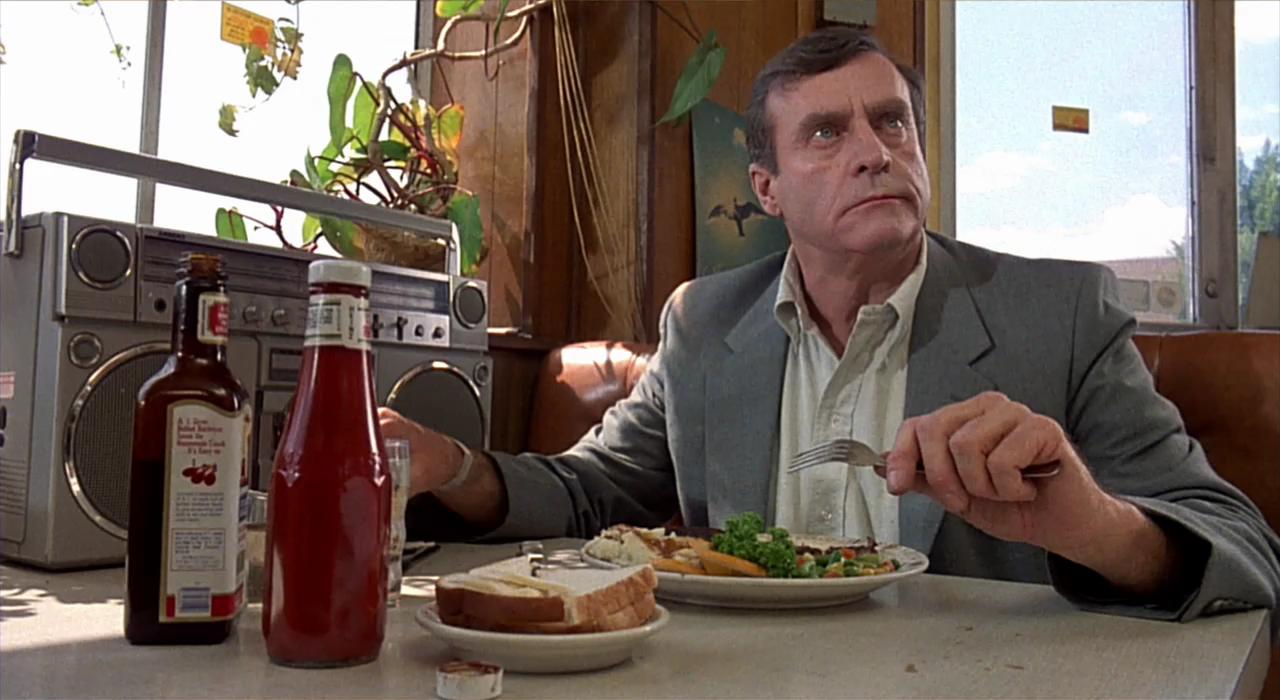
William Boyett
The portrayal of the creature's various incarnations, from the actors to the special effects, are all great. What I particularly enjoyed was the ways in which all the actors feel of a piece with each other,  manifesting the alien's uniquely selfish love of fast cars, loud music and violence. The standout is William Boyett, formerly a heart transplant patient, who brings an adolescent glee to his rampage. Thanks to judicious editing, the dog is also fantastic as the evil alien.

The reflection of pure evil
The only real flaw with the movie is the inexplicable score, which feels like a child playing with an electronic keyboard. It is a testament to the movie that it never detracts from the movie's effect.

Produced on a shoestring budget of five million bucks, The Hidden never feels lacking for anything, and punches far above its weight.

Related reviews

Men in Black: International

If you are new to this blog, I also co-host a podcast on the British girl group the Sugababes, cleverly entitled SugaBros

You can check out the latest episode here. Subscribe on iTunes, or wherever you get your podcasts!

Wednesday, 12 June 2019

IN THEATRES: Men in Black - International

Probationary agent M (Tessa Thompson) is given her first assignment and sent to the London branch, where she falls in with the dashing-but-oafish Agent H.

Together they have to protect a piece of powerful alien techno-and you've already stopped reading.

There are bad aliens. Thor and Valkyrie kill them. The end. No Will Smith/Tommy Lee Jones cameos.


I've been trying to come up with something to introduce this review. So here is the music video for 'Men in Black'.


Best to keep it playing - it will be more fun than this review.

Anyway.......................

What a hollow movie.

What a bland, uninteresting, cookie-cutter release date-in-cinematic-form movie.

This franchise had one good story and while the initial sequels were successful they never captured the strange magic of the first movie: the chalk and cheese dynamic of smith and jones; the deadpan style of Barry Sonnenfeld; the great Vincent D’Nofrio as the villain. With this iteration, we get a sliver of a maybe-interesting idea for a main character, and that’s about it for unique ideas.

Admittedly, the first movie is a pretty slim proposition - the plot barely exists (and was basically re-written in post-production) - yet the ingredients already listed make up for it. This movie sadly proves that Men in Black should have stayed at just one movie.

From the jump something is off - we get another extended title sequence but this one does not end on a joke or really add to the story. And then we get two flashbacks, which do no help: we open on a scene set in 2016, and then transition to another scene in 1998, and then back to the present. It is bizarre, and while the scenes provide important info for our heroes, the scenes feel disconnected from each other, and do not really pay off in satisfying ways.

What makes it worse is that there are moments where it feels like this movie could be way more fun than it is. Once the movie shifts into the present, it feels like the filmmakers are setting up a really cool premise - what if a kid grew up wanting to be a MIB (or a WIB), and actively tried to break in? This is the way we are introduced to Tessa Thompson's Agent M aka Molly, a young woman who witnessed the Men in Black and an alien in action when she was a child, and became obsessed with joining the secretive organisation. 


These early scenes are kind of fun - we get a montage of Molly crashing out of interviews for various government agencies because she keeps asking about the guys in black suits, and then a sequence showing her figuring out how to sneak into MIB HQ. Once she breaks into the building the movie's problems become very obvious.

The big issue is that the movie feels in a hurry, and does not allow anything to grow organically. Thompson's discovery and infiltration of MIB headquarters is so fast, and so easy, and followed so quickly by her becoming an agent, the movie loses what little motivation her character has. She wanted to become an MIB agent - and she does. Sure, she is on probation, but at no point through the rest of the movie does it feel like she is growing and learning how to become an agent. No big obstacles and no real stakes make this movie weightless.

While Thompson is a winning presence, she cannot compensate for how underwritten this character is. Throughout the movie I found it difficult to follow her motivations and to really get a sense of her personality. What does she want? What does she need? We never really find out.

The same goes for her co-star: Chris Hemsworth is an agent who has lost his spark, and has grown careless. Sadly the movie chickens out on making him a real loser - he is still too cool and smart. He never screws up in a big way. Even this shoddy characterisation is for nought because the big obvious twist completely negates his (slim) need for redemption.

In a franchise built on the rapport between two main characters, it is ironic that this movie completely fails in this respect. Neither character starts in a solid place, they don’t really learn anything, and they win at the end because of the actions of a minor character. If they committed to the idea of these characters - a gifted amateur who nobody believed in; a veteran who has lost his motivation - it could have worked. The idea of a character coasting because he already did something heroic, and having to humble himself, could be interesting.

Heck, it would have been funnier if it turned out Thompson is a natural at the job and Hemsworth is unmasked as a useless bro who has been getting by on charm and good luck.


Thompson and Hemsworth do their best, but the script does not give their characters or relationship enough definition to really click. What makes it worse is the ham-fisted way the movie tries to wedge in some romantic tension right at the end of the movie. It is already cliche as hell that subtext is never present in their relationship prior.

On top of its bland-erised characters, the movie is not really about anything thematically. Initially it feels like the movie will be taking a swing at current fights over immigration: Rafe Ifans, Agent C, speaks about aliens in very deragotory terms. It sets you up to expect that he will turn out to be some kind of Trumpian threat - the idea of a xenophobic MIB is interesting, but this turns out to be a character trait that just serves to make H look better when C points out signs of trouble. This aspect of the character is pretty much forgotten once the true villain is unmasked, and C turns out to be on the side of angels.

Once again, the movie takes a punt on turning its established formula on its head.

Past MIB movies are famous for their incidental pleasures (Frank the pug; the various denizens of New York), but this movie features few of the same fun details - Kumail Nanjiani plays a tiny alien soldier who becomes M's bodyguard; there's an alien masquerading as a beard.

F. Gary Gray's direction makes a fatal error of all franchise starters (or re-starters): he does not take the time to build and reveal the world - the movie is moving too fast, and introduces locations through wide shots which the characters then walk into. We are never aligned with Molly’s POV as she discovers this hidden world. There is never any sense of tension, or any really great punchlines to any of the jokes (the 'best' of which are in the trailers).

Despite the number of locations (or because of them) the movie never establishes a unique identity. One of the key things from the original is how specific it is to New York. Here, the movie flirts with James Bond-style location-hopping but never makes that interesting. Rebecca Ferguson shows up as a wealthy arms dealer with an island fortress, but the most noteworthy aspect of her character is that she has a third arm. That’s it.

And the lack of practical effects is really felt. None of the creatures or environments feel lived-in or tangible. Even exterior scenes feel canned and limited in scope. Men in Black 3 is a mess but I feel like this movie is going to age worse - its greatest weakness is not that it is bad, it is just incredibly generic in almost every respect.

The one minor highlight is the score (duties shared by Danny Elfman and Chris Bacon), which recalls Elfman's themes from the previous movies.

I would like to give the movie some kudos (half a kudo?) for resisting the urge to include a pop-in from Will Smith or  Tommy Lee Jones. Whether it was scheduling, money or a creative choice is irrelevant, but it is a testament to how little this movie sparked that I was kinda-hoping the movie would pull a Marvel and feature them in a mid-credit stinger.

If you are looking for an easy rental in a couple months, Men in Black: International will suit your needs. But it is not worth going out to the theatre.

Here's hoping Hemsworth and Thompson get to re-team on something else. They have good chemistry in Thor: Ragnarok and the same is true here. They need a Thin Man or something.


If you are looking for a good Tessa Thompson movie, wait till Little Woods comes out next week.

Related

Little Woods

If you are new to this blog, I also co-host a podcast on the British girl group the Sugababes, cleverly entitled SugaBros

You can check out the latest episode here. Subscribe on iTunes, or wherever you get your podcasts!

Sunday, 9 June 2019

Lisa and the Devil (Mario Bava, 1973)

While on holiday in a Spanish town, Lisa (Elke Sommer) separates from her friends and gets lost.

Unable to find her party, Lisa ends up hitching a ride with an unhappy couple Sophie (Sylva Koscina) and Francis (Eduardo Fajardo). When the car breaks down, Lisa and her companions wind up as guests at a nearby estate where they become uncomfortable guests of the owner (Alida Valli) and her son (Alessio Orano), who develops an unhealthy fixation on Lisa.

While Lisa and the other characters struggle to figure out what is going on, butler Leandro (Telly Savalas) sucks on a lollipop and sits back to enjoy the show...


Directed by the master of Italian horror, Mario Bava, Lisa and the Devil has been on my radar for over a decade. My local arthouse has been running a series of classic films as part of a season on 'identity horror', and Lisa was one of them.

Infamously re-cut and partially reshot by producer Alfredo Leone to cash in on the success of The Exorcist, Lisa... is one of the Italian master’s final works.

After his previous film, Baron Blood, became a big hit, Bava was given complete creative control and it shows - the movie’s atmosphere is strong, the photography is beautiful and the effects are effective rather than realistic. Bava started out in special effects and as a cinematographer - he became famous for his gifts for delivering strong material on the smell of an oily rag.

Aside from his debut Black Sunday, which is regarded as one of the finest horror movies ever made (it is one of my personal favourites), Bava is known as the originator of the 'Giallo', a subgenre of mystery thrillers renowned for their emphasis on hyper-violent murders. From Blood and Black Lace (1964) - regarded as one of the earliest gailli - Bava's subsequent additions to the genre push it in different directions - Hatchet for the Honeymoon plays the action out from the murderer's perspective; Twitch of the Death Nerve pushes the genre to its most nihilistic extreme, with multiple murderers fighting over an inheritance until no one is left alive.

A surreal descent into hell, Lisa and the Devil is only tangentially related to the genre, but in its focus on a small group of characters in an isolated location, it feels like a perverse inversion of the template - the story that Lisa stumbles into feels so familiar, and is treated so cursorily that it almost comes across as parody.

Even the components - a wealthy family on an isolated estate, riven by deceit and perverse urges - feel past their use-by date.

Once the players are stuck on the estate, any lingering semblance of cause and effect, time and place, fall apart.


One of the primary attractions of Mario Bava's work is his unsettling aesthetic - the movie features super bright technicolor, mise-en-scene crowded with creepy dummies, and judicious use of the old fish-eye lense.

In certain respects, it feels similar to The Shining - the isolated setting; the 'daytime nightmare' aspect of the photography (Bava's use of super bright technicolor is incredibly unsettling); the ultimate revelation that Lisa - like Jack Torrance - is and has always been a part of the family’s story

There are some dead spots, and most of the acting is wooden, but the big selling point - aside from Bava's aesthetic - is Telly Savalas as the satanic Leandro.


From the outset, Bava establishes Leandro's control over the movie, with a close-up of Savalas smiling straight at the camera.

Bava does not hide Leandro's true identity - Sommer literally walks around the corner from a massive fresco of the Devil, and immediately runs into the eerily similar Savalas, who is buying a life-size dummy of a man.

In the 'story', Leandro is the butler to this creepy family, both servant, overseer and an audience for the character's antics. For a majority of the runtime, his Satan is basically a background presence, observing and commenting on the other characters as they bumble around the estate.

He talks shit behind their backs, seems to delight in their panic and frustration, and he also seems a little bored by the exercise. Savalas plays the role with a droll charm, pushing his role's servility just ever-so-slightly over the top.

While Sommer is buffeted by events, it feels like the family are running through the same melodramatic storyline over and over again. Savalas’s Devil can barely be bothered to play his role. You get the impression he's played versions of this scenario out countless times already, constantly tinkering with the movements and identities of the characters to see how the scenario  plays out.

At times it feels like Leandro is pushing the story toward the ending because he wants to skip the boring parts - like exposition or character development. The most interesting murder is a spur-of-the-moment act - Sophie runs her husband over after he mocks the fact that her lover - their driver - has been killed.

Every time the movie feels like it is building toward the melodrama its story implies, Bava undercuts it, or focuses on Leandro doing something totally banal - like talking to a dummy, or attempting to bum a cigarette off a guest (and then, in the film's funniest moment, returning it as soon as his 'boss', the Countess, looms up behind him).


Savalas is so magnetic, he gives Lisa and the Devil a weird sense of gravity - the story may make no sense, the English dub may reduce the other characters to cardboard cliches, but Savalas is so good and in tune with Bava's direction that the film does not collapse.

Through Savalas, the film gains an offbeat, pitch-black vein of comedy that adds to the movie's off-kilter atmosphere.

It is not in danger of becoming my favourite Bava, but Lisa and the Devil is definitely worth checking out, and Savalas makes for one of the more fascinating versions of the Prince of Darkness I have seen.


If you are new to this blog, I also co-host a podcast on James Bond called The James Bond Cocktail Hour. Every episode, we do a review of one of the books and one of the movies, picked at random. 

In the latest episode we discuss the portrayal of women in the Bond franchise. Subscribe on iTunes, or wherever you get your podcasts!