Saturday, 19 October 2019

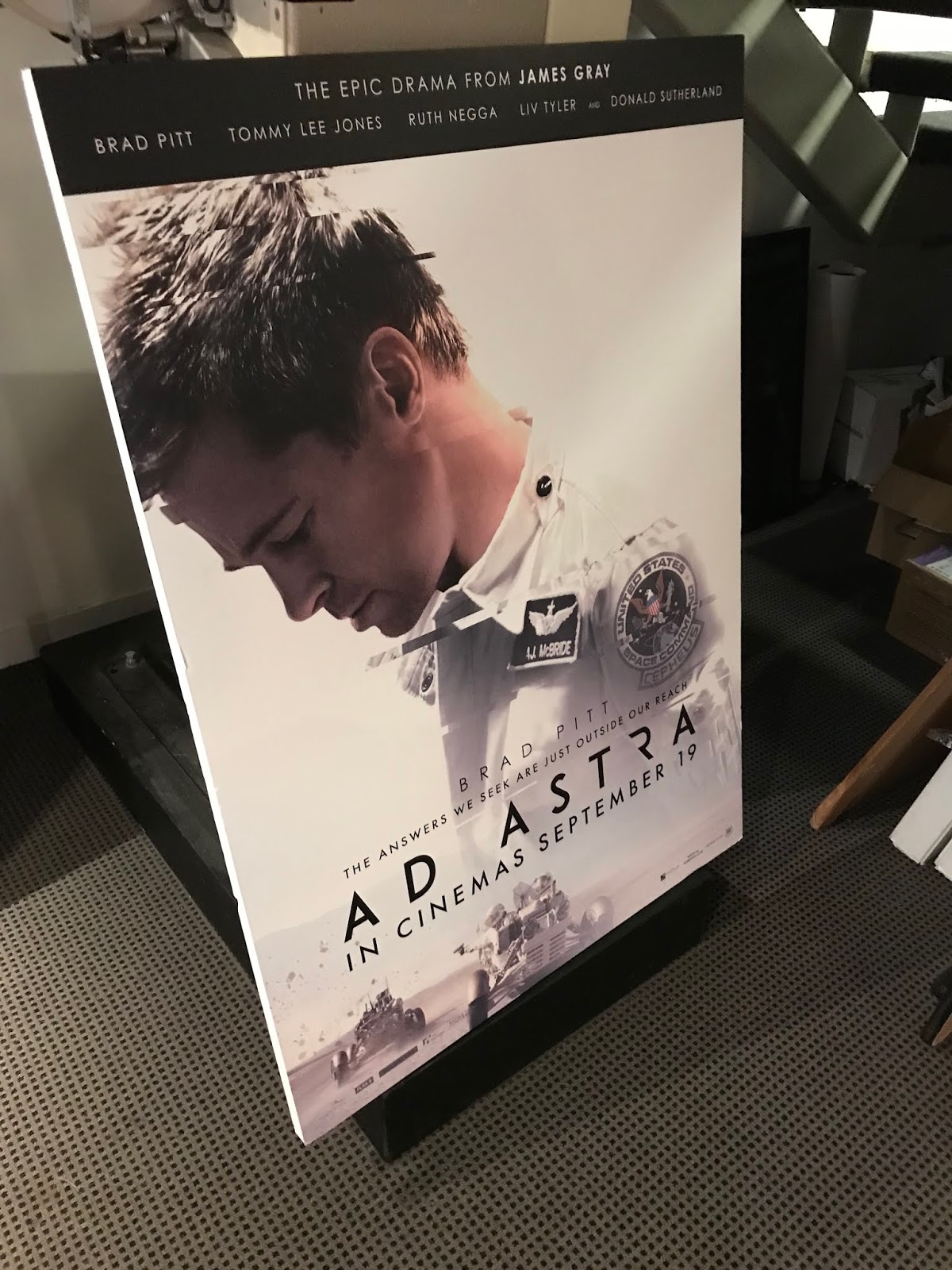
IN THEATRES: Ad Astra

30 years after his father's disappearance on a long-range mission to discover extraterrestrial life, astronaut Roy McBride (Brad Pitt) finds himself on a mission to the outer reaches of the solar system, to locate the source of an extraterrestrial phenomena that is causing chaos throughout colonised space. To do so, he must try and make contact with the one person he never thought he would hear from again...


Funnelled through the story of a man trying to unpack the trauma of his father’s abandonment, Ad Astra is one of the most enjoyable experiences I have had this year, and a fine closing statement to the creative instincts of the now-deceased 20th Century Fox.

While I have no interest in eulogising a corporation, after a year of releases that left me frustrated and/or indifferent, Ad Astra felt like a breath of fresh air.

It does use an old trope - an ex-spouse (played by Liv Tyler in brief glimpses) who exists purely as a device for showing the central character's growth. That and the narration feel like the most conventional aspects of the film, but they were not fatal flaws.

While the movie is big, and is based on visual effects, the restraint in these aspects is one of my favourite qualities in the film. 

James Gray keeps his camera anchored to Pitt’s POV - this future is tactile and functional. The world-building is largely implied - for once product placement in a movie feels like a critique - on his Virgin flight to the moon, a blanket and pillow cost 120 credits. In space Capitalism is still on the march, but is straining against the need to survive. 

The spread to other worlds has not led to a fundamental shift in how people treat one another - the military is still engaged in cover-ups; capitalism is funnelling through everything and the moon - though borderless - has become the new frontier in humanity's scrabble over resources.

PItt's performance is just like the movie - small, insular but surprisingly empathetic. Which is remarkable considering how emotionally stunted the character is - constantly evaluating stress levels, Roy comes across as a machine, a man hollowed out by his desire to be the best astronaut he could be, driven by the ghost of a father he both loves and resents.  

Aside from the familiarity of the wife character, the only vague niggle I had was Pitt’s narration, which is a tad obvious. That might be the effect of how effective I found his performance.

For the majority of the runtime, it feels like the the character is just as driven as his father (Tommy Lee Jones), using whatever means necessary to accomplish his objective. There are deaths involved, but Gray muddies the waters over his responsibility and involvement in them - in this future, militarism has not dissipated, but become a part of space - wherever mankind goes, so to does subterfuge, violence and greed.

Which makes the film's final epiphany so satisfying. 

What starts out as an intergalactic Heart of Darkness turns into a tale of a man reconnecting with his humanity. For a film that has seemed so focused on containment of emotion, and prioritising survival over all other considerations, the finale of Ad Astra is ultimately about recognising not that we are alone in the universe, but that in recognising that fact we have to  in turn focus on one another.

A quiet, understated exploration of a familiar question, Ad Astra's rebuttal of the existential dread of humanity's singularity in the universe is one of the most moving experiences I have had in a cinema this year.

If you are new to this blog, I also co-host a podcast on James Bond, The James Bond Cocktail Hour

You can subscribe on iTunes, or wherever you get your podcasts.

Friday, 18 October 2019

The Craft (Andrew Fleming, 1996)

When Sarah (Robin Tunney) moves to a new school, she finds herself the focus of a trio of outcasts (Fairuza Balk, Neve Campbell and Rachel True). The trio are a fledgling coven of witches and believe Sarah is the 'fourth' they have been waiting for.

With Sarah on-board, the coven soon realise that their spells are working, and they quickly become intoxicated with the power they have unleashed, using it to rectify their individual problems.

However, when one of their number takes it too far, Sarah has to figure out whether she sides with her friend, or stops her before more people get hurt...


I have heard about this movie for years, but never felt the desire to see it. Partly it was down to sheer misogyny - if it was for teen girls it must be bad. I saw the poster and thought it was some silly YA movie. Thankfully, times and people change - that and every woman critic I read brought it up in a million different reviews of other movies I liked and my bullshit walls began to crumble.

To celebrate Halloween my local arthouse is hosting a festival of witch movies, including this 1996 supernatural drama. Since my curiosity was piqued, I decided to check it out.

Watching The Craft, two things were quickly apparent: First, while I was vaguely aware of the similarities, it is ridiculous how much Charmed ripped this movie off. Once 'How Soon Is Now?' starts playing...

My second takeaway was how mature the movie’s themes are. The movie’s trailer made it look like a typical 90s teen movie, but aside from the soundtrack, there is little about the movie that feels dated.

From a 2019 vantage, the movie’s portrayal of young women discovering their own power is fascinating - the characters use magic as a vehicle for overcoming the things that oppress them. I went back and read the oral history the Huffington Post released around the 20th anniversary, and the filmmakers emphasised how important it was to ground the characters' desire for power in real-world needs.

Sarah is recovering from a failed suicide attempt and a yearning to know her mother who died during child birth; Nancy (Balk) is poor and ostracised as a 'slut' by the upper-class student body; Bonnie (Campbell) is ashamed of her burn scars that she hides under heavy clothing; and Rochelle (True) has to contend with racist bullying from a young Christine Taylor.

Because of the period when it came out, I was worried the movie's tone would be glib. There is a superficial irony to a lot of 90s genre flicks that makes me leery to check out movies I have never seen, but The Craft was refreshingly direct in tackling a bunch of issues people, particularly young women, face - suicide, slut-shaming, consent - without undermining them.

Even the sequence where a hypnotised Nic (Skeet Ulrich) attacks Sarah when she refuses him does not feel comedic. The movie takes its leads and their dilemmas seriously, and that gives their exploration of magic a greater sense of escape and necessity. 

On top of this, there is an earnestness to the portrayal of magic that gives the movie stakes - plus the lack of visual effects gives the movie’s set pieces a real sense of weight. 

Tonally, the movie rides the line of taking itself seriously, while allowing for some great comedic beats - the 'stiff as a board' scene is great, and even smaller moments like the visual of our gothic-up heroines sitting on a bus is hilarious. The movie has a sardonic sense of humour that does not feel rooted in the faux irony and self-awareness of the era, and the movie never ridicules the characters’ beliefs.


The four leads are great: For some reason I always associate Robin Tunney with her appearance in the underwhelming Arnie vehicle End of Days and the TV show The Mentalist. She's pretty solid in those projects, but this is the first performance I have seen where it feels like she gets to run the gamut - she's fragile, she's ballsy, and she centres the movie.

As Sarah's future nemesis, Balk motors through the movie like a berserker. As Nancy, Balk boasts a weird charisma that seems to be both a byproduct and a reaction to the character's deep sense of loneliness. 

While I enjoyed their performances, it felt to me like Campbell and True’s characters needed a little more - I liked their subplots, but I was not quite sold by their mindless following of Balk during the final confrontation between the former friends. 

That aside, I really enjoyed The Craft. I wish I had checked it out sooner. 

If you are new to this blog, I also co-host a podcast on James Bond called The James Bond Cocktail Hour. Every episode, we do a review of one of the books and one of the movies, picked at random. 

You can also check out my other podcast SugaBros at the same link.

Sunday, 1 September 2019

IN THEATRES: Angel Has Fallen

After an assassination attempt on the US president (Morgan Freeman), Secret Service agent Mike Banning (Gerard Butler) is the chief suspect. With the government on his tail, Banning goes on the run to find the real villains before an international crisis turns into war.


After the concept-focus of the original, and the more expansive sequel, Angel Has Fallen sees the head stab-happy series reach an unlikely new mode: respectability.

Gone is the outright xenophobia of its predecessors. Reduced is the red meat machismo. Muted - sadly -are the head stabs. 

Instead, more focus is placed on fleshing out Banning, and casting him as a veteran dealing with the physical and psychological traumas of his various wars.

Perhaps as a reaction to the super-heated racism of its predecessor, the threat this time is a group of amoral military contractors using an assassination attempt on the president to justify an escalation of the US’s military posture.

The budget is smaller this time, and the action somewhat more compressed, with the genre touchstone is The Fugitive, with a bit of First Blood mixed in.

While the budget cuts are visible in the reduced supporting cast of big names and smaller set pieces, the movie does not feel cheap. Compared with the $60 million London Has Fallen, the $40 million Angel never feels like it is reaching beyond its means. There is some ropey CGI towards the end, but nothing compared with the exploding bridges and buildings of London, which feel like clips out of a 2007 video game. 

The reduced budget might have also had a hand in the film's focus on its characters. Considering the source material, it might seem laughable to suggest that characterisation is a selling point for a Mike Banning movie, but Angel is a savvier picture than advertised.


Butler is not the most nuanced performer, but his obvious enthusiasm for Banning has been part of the draw of these movies. He really tears into this iteration of the character, and emphasises how drained and disoriented Banning has become. He is like a veteran prize fighter, punch drunk and increasingly weary of the one thing he he is good at. I was surprised at how much Butler was willing to expose himself. 

Once Banning runs into his dad Clay (Nick Nolte) in the second act, the movie gains two things it has never had - pathos and wit. 

Continuing the film's focus on the toll war takes on its participants, Clay is a veteran who cannot deal with the world and has literally retreated into the woods. Nolte gives this movie a new centre of gravity - even Butler seems to be on a different plane in their scenes together.


Weirdly, for a franchise that sold itself as a brutally earnest (and earnestly brutal) action extravaganza, this movie feels more at home when staging verbal exchanges between two damaged men talking about their pain than in any of the combat sequences. When Nolte and Butler are not together, the movie loses its spark.

The movie-makers clearly recognise they are onto something with Butler and Nolte, ending the movie with a mid-credit sting that gives the series its first genuine laugh. 

Danny Houston has become a shorthand for smug, low-aiming-for-high status villains, but he is pretty good here. It would have been more interesting if he got to play a different kind of role but as with our hero, the script does try to give his antagonist some colour - like Banning, he is a veteran but unlike Mike he misses the action. There’s not a lot more to it, but it gives their conflict some symmetry.

While the focus on character adds some meat, as far as the direction goes I was a little underwhelmed - there were too many points where the camera was too close to whatever was being photographed, with awkward editing making some of the close quarters combat incoherent. 

Which is a pity because the setpieces conceptually are pretty good - I especially liked the truck chase (although I wished I could see more of it). 

There is a great moment in the final fight, which takes place on the roof of a building, where the filmmakers cut to a wide high-angle of the entire location, so we can see where the actors are in relation to each other as they dodge and weave behind cover.

It is a weird thing to say but this might be the most well-written instalment in this franchise while simultaneously being the most underwhelming in the areas that made its predecessors so memorable.

While it may not satisfy you in the ways you have come to expect, Angel Has Fallen brings new things to the table, and makes the prospect of a Mike Banning Goes Fourth rather exciting.

If you are new to this blog, I also co-host a podcast on the British girl group the Sugababes, cleverly entitled SugaBros

You can subscribe on iTunes, Spotify, or wherever you get your podcasts!

Friday, 23 August 2019

IN THEATRES: Once Upon A Time In Hollywood

1969. TV star Rick Dalton (Leonardo DiCaprio) has hit rock bottom. Formerly the star of Bounty Law, his movie career has stalled and he is consigned to guest shots on TV shows, playing villains of the week.

In juxtaposition to Dalton's plateau, director of the moment Roman Polanski (RafaÅ‚ Zawierucha) and his new bride Sharon Tate (Margot Robbie) have moved in next door.

While Dalton tries to sort out his career and life, his stuntman/friend Cliff Booth stumbles into the circle of a strange group of hippies led by a mysterious man named Charlie...


This movie feels like the end of the road. Not just within the text, but both for Tarantino's career, and the type of cinema that he represents.

Tarantino has said in the past that he only wants to make ten movies because he is afraid of running out of gas. It feels like he might have hit that point.

This movie is almost three hours long. This is not alien territory for Tarantino, but if you are going to go for an epic runtime, you really have to pay it off. This movie does not even begin to pay the interest.

Firstly, it feels like a retread of Tarantino's past films, from the historical re-writing of the climax to the use of old-school production techniques. We even get a killer stuntman (allegedly).

DiCaprio's travails as Dalton are a highlight - he is a hopeless narcissist, but DiCaprio's fragile, exposed performance makes Dalton for more sympathetic than he may have appeared on the page. When the movie is solely focused on this vain man trying to rediscover his mojo, the movie is kind of involving.

Watching him struggle to remember lines and stay off the sauce, or cry in front of a more dedicated child co-star, it gives this movie something it otherwise sorely lacks: depth.

Outside of Dalton's antics, the rest of the movie just seems to be in neutral, with little sense of connection or development.

When we are watching Dalton try to rediscover his acting toolkit, the movie has shape and purpose. When we are watching 55-year-old Brad Pitt throw a cartoonish Bruce Lee around, the movie feels juvenile and frankly, old-fashioned. The sequence with Lee (Mike Moh) has been criticised for reducing Lee to a punch line, but alongside that I had no idea what the purpose of the scene was for Cliff's character. Aside from setting him up as superhuman, all it does is make him look like an asshole (PLUS by including Lee, it just highlights how un-involving Dalton's story is, while ignoring the more dramatic story of an Asian man working in the Hollywood system).

He is intended to be a mythical man of action, but beyond that? It could be Tarantino's attempt to push the archetypal man's man into full-on sociopath, but I am struggling to see what the ultimate intent is. That the traditional mode of the loner old white guy can be bad?

Part of the reason why I found it hard to figure out what this movie is about is really a result of how slapdash the movie is. Just at a structural level, it never really feels like it is building toward anything.

Most of the action takes place in February, a specific which proved to be completely irrelevant - is it meant to be pilot season? If so, then why is Dalton starring in Lancer, a show which premiered the previous year?

About two-thirds of the way through the movie, there is a time jump that feels totally inexplicable but is only necessary to get us to that fateful night in August, 1969. There is one scene which features a flashback within another flashback. The movie features an entire subplot based around Sharon just enjoying life which will probably appeal to her fans, but which just adds more minutes to the runtime.

If you have no knowledge of the Manson murders this movie probably feels even more directionless than I found it, and I am only know the bare bones.

Speaking of which, I am still trying to figure out what Tarantino is trying to say with his portrayal of the Manson Family and what they did. For most of the movie, they are an unseen presence, and the movie seems to be -through Dalton's story - building toward some kind of end of the road metaphor via the 'death of the sixties'. It also feels like a movie that will sync with what really did happen.

But then Tarantino tries to change what happened, and everything goes up in the air: after an altercation with a drunken Dalton outside Tate's home, the killers decide to strike his house first, and come face-to-snout with Cliff's pitbull Brandy.

We then get a comical, hyper-violent set piece during which a dog attacks multiple people, Brad Pitt uses a can of dog food to brain Sadie Atkins, who is then torched by a flame thrower. While the device is similar, the intent is baffling.

In Basterds, the final conflagration in the theatre works because it uses the power of cinema as an in-text weapon, while also offering a prime example of how cinema can provide primal emotional catharsis (like killing Nazis).

In Once Upon A Time..., it is nigh-on impossible to get what the intent is: Are we meant to rejoice that the Family are killed? If so, what is he saying by having Tate's saviour being a self-obsessed TV star and a (allegedly) wife-killing stuntman? It feels like an attempt to muddy the waters of our anti-heroes' morality, but without any greater point behind it.

That is ultimately the deeper problem I have with this movie. There is a hollowness at the heart of Once Upon A Time In Hollywood that I could not shake off.

If you are a fan of Tarantino or the period, you might be satisfied - but the directorial flourishes have been done before, and the historical context is never justified to a meaningful degree (or a near-three hour runtime).

If you are new to this blog, I also co-host a podcast on the British girl group the Sugababes, cleverly entitled SugaBros

You can subscribe on iTunes, Spotify, or wherever you get your podcasts!

Friday, 16 August 2019

NZIFF 2019: The Art of Self-Defense

Shy and retiring, Casey (Jesse Eisenberg) spends his life in the background and minding his own business.

After a mugging, Casey's already shaky self-esteem is shattered. He spirals, seeking solace in anything that will make him feel safe.

After he wanders into the local dojo, Casey falls under the sway of the charismatic Sensei (Alessandro Nivola) who runs the school.

As he builds his skills, Casey gradually realises that there is more to the school and its macho leader than he initially perceived...


A pitch black comedy about toxic masculinity, The Art of Self-Defense was the first film I caught at this year's New Zealand Film Festival.

What defines a man? According to Sensei, unarmed combat, heavy metal music, and a German Shepherd.

Visually, this movie felt like a meeting point between comedy, and the vocabulary associated with martial arts training sequences – flat, symmetrical compositions, with flat (ish) lighting. The way this movie is shot is designed to keep all the characters at a remove to highlight their ridiculousness, but it also feels like a satire of the way Hollywood has framed martial arts.

It may seem minor, but the lack of mise-ene-scene and the focus on shots which emphasised the uninviting atmosphere of the dojo, helps to give Sensei the sense of mysticism and power that he clearly wants to emanate.

His spartan lifestyle comes across as sterile and insular, rather than a signifier of any kind of enlightenment. It also just feels like a middle-aged loser who does not know how to make the dojo a financial success.

The performances are terrific - Eisenberg walks the line of audience sympathy. While it is easy to empathise with him after the mugging (and after his dog dies), he finds different shades within his familiar persona to bring out the festering rage underpinning Casey’s meekness.

The other standout is Alessandro Nivola as Sensei. Deadpan and dead-eyed, Nivola is hilarious and terrifying as Casey's nemesis, delivering his macho pronouncements without a hint of irony. While I have been aware of his existence, the only credit I can recall seeing him in is Face/Off. After watching him in this movie, I am eager to seek out more of his work.

Imogen Poots has had a rough go of it in Hollywood. As Sensei's best student, Anna, she is like a contained detonation. Although relatively muted, she is almost scarier than Sensei, stalking through this movie like a lioness searching for prey.

Cold-blooded and blood-soaked, The Art of Self-Defense always very funny, but there is little release from the laughs.

From the outset it is clear that Sensei's arbitrary rules are really just his own misogynistic assumptions, but the lesson Casey ultimately learns is that strength is not based on rules but breaking them – his victory over Sensei is merely one form of toxic masculinity by another.

Casey may triumph at the end, but the end of Sensei does not mean the end of the system and philosophy he has created - which might be the film's greatest punch-line.

If you are new to this blog, I also co-host a podcast on the British girl group the Sugababes, cleverly entitled SugaBros

You can subscribe on iTunes, Spotify, or wherever you get your podcasts!

Monday, 12 August 2019

NZIFF: The Gangster, The Cop, The Devil

After he survives a serial killer's assault, a crime kingpin (Ma Dong-seok) turns to the dogged cop on his tail (Kim Mu-yeol) and makes him a proposition: he will assist the cop to hunt down the killer, but whoever gets to the perp first gets to dispense their own version of justice...


A pop for the John Wick set? Ocean's Seven? 

The Gangster, The Cop, The Devil should not work. What it does well is tone - it does not dwell on the villain's crimes, and while the gangster's acts have a layer of black humour, it never feels like the movie condones it.

Written and directed by Lee Won-tae, The Gangster, The Cop, The Devil is pure, unapologetic pulp. A darkly comic romp about an unlikely pair of crime fighters.

As the gangster, Ma Dong-seok (most known for his turn in Train to Busan) is the standout - juxtaposing brute force and slow-burn reactions, he seems to have the best understanding of the movie's tone, moving effortlessly between playing to the stakes of the situation, and providing a straight man to the incompetence of his subordinates.

In a role that could be rote, Kim Mu-yeol gives his good cop a passionate sense of right and wrong - his enthusiasm for his work is so heightened it becomes a target for comedy. What makes this character interesting is how the movie puts him in situations that differentiate him from just being an action hero. He is not the most physically capable character, or the smartest, but he is the most driven. He is revolted by the gangsters' methods, and is revolted by violence, crying over the body of a man he kills. As the devil, Kim Sung-kyu is fine - the role is fairly small, compared with his co-stars. The character is more of a catalyst for our anti-heroes to come together.

Stylistically, the movie plays to its roots: Every shot looks like something out of a comic book - the night-time exteriors are filled with vivid colours and chiaroscuro. The score is eclectic - when the pair come up with their plan, the score reminded me of David Holmes' jazzy scores to Out of Sight and Oceans 11. While there are some moments of darkness and violence, the overall vibe is almost akin to a heist movie, as a group of gangsters and cops join forces to hunt down the serial killer.

While it is fun, there is a vague sense of the movie feeling like a combination of different tropes. It also feels a little non-specific in context. Exchange knives for guns and this movie could be a Hollywood product (apparently, the rights have been bought by Sylvester Stallone). The key difference that elevates the movie is tonal - juggling between a buddy cop movie and a serial killer thriller, the movie never leans too hard toward either comedy or the grue, which prevents it from ever feeling distasteful.

An odd beast when you dissect its parts, but that is part of what makes The Gangster, The Cop, The Devil so much fun.

If you are new to this blog, I also co-host a podcast on the British girl group the Sugababes, cleverly entitled SugaBros

You can subscribe on iTunes, Spotify, or wherever you get your podcasts!

Sunday, 4 August 2019

IN THEATRES: Hobbs & Shaw

Luke Hobbs (Dwayne Johnson) and Deckard Shaw (Jason Statham) are brought together to track down a double agent who has stolen a virus with the potential to wipe out the human race. The assignment gets personal when Shaw discovers their target is his sister (Vanessa Kirby), and the real bad guy is a super-powered assassin Brixton (Idris Elba).


In a race against time, Hobbs and Shaw have to learn to work together in order to save the world.


This movie is like getting to eat a plate of my two favourite ice creams for dinner. I liked it at first but then the plate is empty and I’m sunk in my seat regretting my own indulgence. I missed the rest of the ensemble - especially Tyrese (a phrase I thought I would never say).

Apart from their fighting styles, there is no real difference between our heroes. Hobbs is a tough guy one-liner machine; Shaw is a tough guy one-liner machine. Their conflict amounts to a dick-measuring contest, with Shaw's sister the unsuspecting battleground.

If I was to compare this movie with anything, it feels like a more polished Tango and Cash, with two superficially mis-matched leads who really are not that different.

I can barely remember anything in these movies but I was actually wondering if the movie was going to finally deal with the fact that Shaw killed longtime family-member Han (Sung Kang) - it would have been something.


This movie really crystallised how uninteresting - in 2019 - Johnson and Statham playing into their established personas is. In the ensemble format of the previous Fast movies, their antics feel special: in a 160(!) minute movie, it feels tired.  

Beyond this, both actors have proved themselves to be far more interesting when they are playing against type (most recently, Johnson's creepy re-working of his A1 persona in Central Intelligence; Statham's outright parody of his filmography in Spy). In Hobbs and Shaw, we are presented with the broadest, simplest images of its stars. Shorn of its parent franchise's style and ethos, it would have been interesting to see this movie define itself as a self-sustaining entity.

And now onto the self-proclaimed bad guy.


I felt bad for Elba. Once again, he is stuck playing another generic role. He is a great actor who is frankly far better than this kind of cookie-cutter nonsense. The only moment that felt like something new was his little chuckle when he realises he has been abandoned by his paymasters.  

One thing that I always liked about the previous Fast movies is that they never seem to plan ahead. This is the first one where we are promised a bigger baddie. It undermines Brixton, who just becomes a lackey for a bigger villain we never get to see.

The set pieces are pretty good, although the film never really capitalises on having a villain who is "Black Superman". Johnson and Statham are already hyperbolic action heroes and the movie never really delineates between the skills of heroes and villain to give their various confrontations any sense of stakes. 


Vanessa Kirby is really good - the script is smart enough to never turn her into a damsel in distress. She manages to get herself out of every situation she is in, although there are a few moments (such as the scene where she is leaping from roof to roof in the bad guy's underground base) where she shares her co-stars' aversion to physics (which in turn makes Elba's bad guy even less impressive).

In a more retrograde move (that really reminded me of Messers Tango and Cash), part of the title pair's enmity comes from Shaw's belief that Hobbs has eyes on his sister. Thankfully the movie soft-pedals this maybe-attraction. Maybe because their antagonism seems so sexual, this subplot comes off as gross. Hopefully this is completely ignored in the probable sequel.
Hobbs and Shaw is a serviceable enough popcorn flick, but it feels like the law of diminishing returns is catching up with the Fast and Furious franchise.

If you are new to this blog, I also co-host a podcast on the British girl group the Sugababes, cleverly entitled SugaBros

You can subscribe on iTunes, Spotify, or wherever you get your podcasts!